
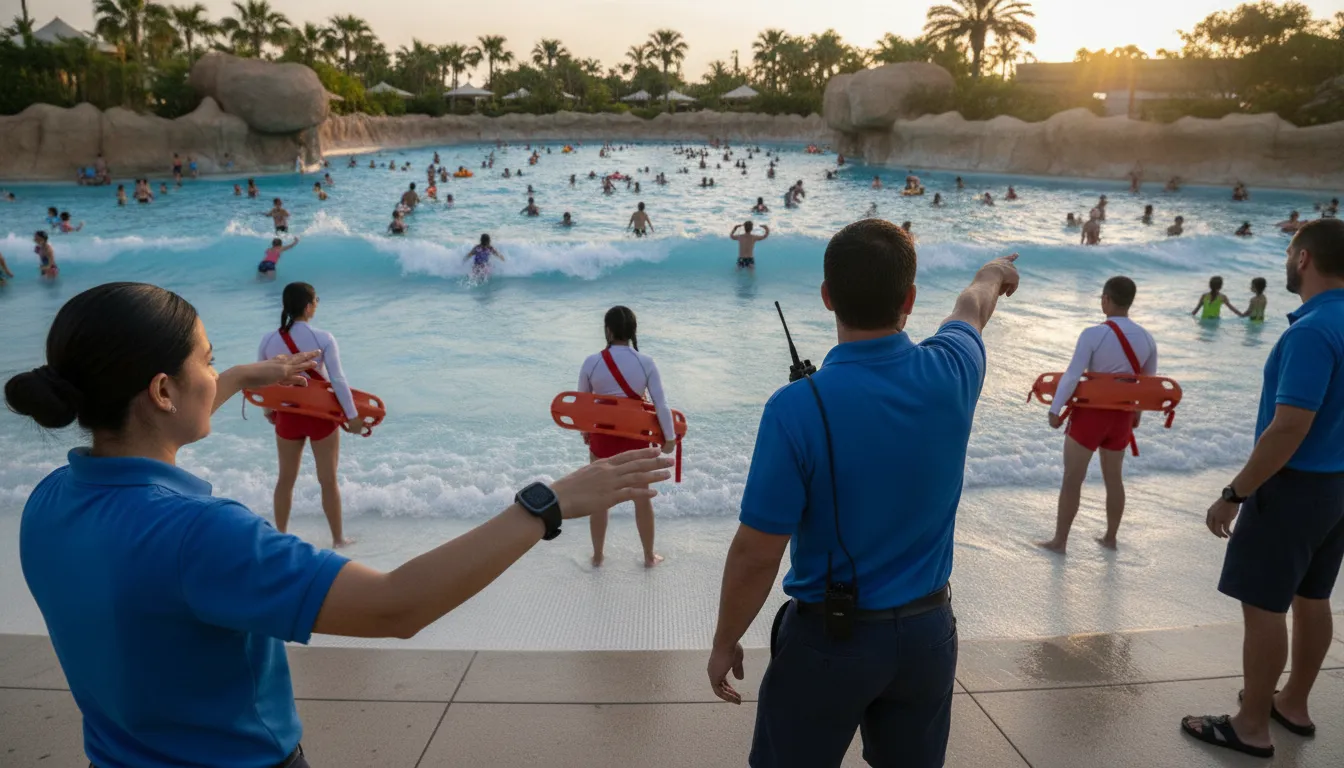
Waterpark operators manage moving water, crowded attractions, changing sightlines, and constant background noise. The best drowning prevention technology for waterparks should help trained staff recognize a possible emergency and respond through a clear workflow. Active supervision remains the foundation of safety.
The strongest choice is a layered safety system that fits the park's water conditions, staffing plan, alert workflow, and budget. Wearable drowning-detection technology can add another signal for lifeguards and designated staff without replacing supervision, rescue training, or emergency procedures.
A product demonstration alone cannot answer whether a system fits a wave pool, play area, lazy river, or slide exit. Aquatics directors, operations leaders, and risk managers need to examine detection, alert delivery, deployment, maintenance, and accountability together. This guide provides a practical framework for that evaluation and explains where WAVE's wearable approach may fit.
What should waterparks look for in drowning prevention technology?
Evaluate drowning prevention technology by its detection method, alert path, environmental fit, deployment requirements, daily readiness, and reporting. The right system supports trained lifeguards and staff instead of asking technology to carry the entire safety program.
Begin with the response problem rather than a list of features. A waterpark may have several zones operating at once, and each zone can create a different combination of water movement, glare, crowding, and noise. A useful safety layer should make a possible event easier to identify and route to the people responsible for the next action.
It should also fit the park's existing safety program. The Centers for Disease Control and Prevention's drowning-prevention guidance emphasizes close supervision around water, including when lifeguards are present. Technology is therefore one part of a broader plan. It cannot guarantee that every event will be detected, and it should never be presented as a substitute for lifeguards or emergency action procedures.
Use these questions when comparing vendors:
- What does the system detect? Ask whether the technology identifies prolonged submersion, lifeguard water entry, or another defined event. The trigger should be understandable to supervisors and connected to a documented response.
- Where does the alert go? In a wave pool or play area, a distant audible alarm may not be enough. Confirm whether alerts reach assigned staff through vibrating bracelets, facility notifications, spoken alerts, or another channel.
- Will it fit the park's conditions? Review the system in clear water, dark areas, murky conditions, spray, waves, glare, and crowded attractions. A solution that depends on a consistently clear camera view may require different infrastructure from a wearable system.
- How much construction is required? Determine whether installation requires drilling, cabling, permits, attraction downtime, or permanent changes. A wireless system may reduce disruption, but the facility still needs a thoughtful zone and coverage plan.
- How will staff use it every day? Ask about device assignment, alert acknowledgement, testing, battery checks, training, and replacement. A system is only useful when staff understand it and keep it ready.
- What information supports review? Look for equipment status, alert history, staff permissions, and reporting that can help leaders identify process gaps. Operational data should support improvement, not create a false promise of complete protection.
WAVE's GUARDian Hub system is designed as a wireless command and communication center for lifeguards, staff, and swimmers. Its wearable approach can provide another alert path in supervised aquatic environments without requiring a facility to redesign every attraction around fixed camera hardware. Operators should validate the configuration against their own risk assessment and emergency action plan.
How do you compare the best drowning prevention technology for waterparks?
Compare each option by environmental fit, alert delivery, installation, maintenance, and how clearly it supports trained staff. Waterpark operators should select a layered approach that works in the real attraction, not simply the technology with the most advanced label.
Comparison should focus on operational fit, not on which category sounds most advanced. Waterparks commonly evaluate wearable sensor systems, camera-based monitoring, and broader safety workflows. These approaches may serve different conditions, so a responsible comparison starts with the park's attractions and response plan.
Wearable detection systems
Wearables can place a defined detection signal close to the swimmer or lifeguard. WAVE's AquaSense swimmer wearables are intended to monitor submersion, while lifeguard tags can identify water entry. The value is not a promise of automatic rescue. It is an additional signal that can reach staff when a visual scan is difficult.
Camera-based monitoring
Camera systems can be useful when a facility has suitable visibility, camera placement, network access, and a budget for installation. Operators should ask how glare, spray, waves, dark areas, swimmers crossing paths, and water clarity affect the system. Construction and maintenance requirements also belong in the comparison, especially when attractions operate on a seasonal schedule.
Layered safety operations
The strongest evaluation includes the human workflow around any device. Identify who receives the first alert, who confirms the event, who contacts the zone team, and who documents the response. The peer-reviewed review of technology approaches to water safety can provide useful context, but each park still needs site-specific testing and procedures.
| Evaluation area | Questions for operators | Why it matters |
|---|---|---|
| Detection | What event triggers an alert? | Staff need a defined signal and response. |
| Environment | How does the system perform with waves, glare, spray, or murky water? | Real attraction conditions determine fit. |
| Deployment | Does installation require construction or downtime? | Disruption affects the rollout and operating budget. |
| Alert path | Who receives, confirms, and escalates an alert? | Clear ownership reduces confusion. |
| Readiness | How are devices assigned, tested, charged, or replaced? | Daily availability matters as much as the purchase decision. |
A waterpark can use this framework to compare products without treating one feature as a complete answer. The goal is a system that staff can understand, test, and use within the park's established safety program.
Can the best drowning prevention technology for waterparks support wave pools?
Wearable monitoring can add a direct alert channel in noisy, crowded attractions where movement and changing visibility challenge observation. It supports lifeguards by signaling defined events, while staff remain responsible for confirming and responding according to the park plan.
Wave pools and interactive play areas combine several challenges that can compete with visual scanning. Water movement changes, swimmers cross paths, guests create distractions, and music or pumps can make verbal communication harder. A wearable alert can give the response team another signal to act on while lifeguards continue scanning and managing the zone.
Alert design matters as much as detection. WAVE describes a workflow that can use lifeguard tags, vibrating staff bracelets, and spoken facility alerts. A park should decide which alerts belong with the zone team, which should reach supervisors, and when a broader facility signal is appropriate. Those decisions should be documented before peak attendance.
Wearables may also help a park evaluate attractions that are difficult to retrofit. WAVE describes its equipment as wireless and suitable for clear, dark, and murky water. This can give an operator another option when fixed cameras are impractical. It does not remove the need to test range, placement, signal behavior, and staff response in the actual venue.
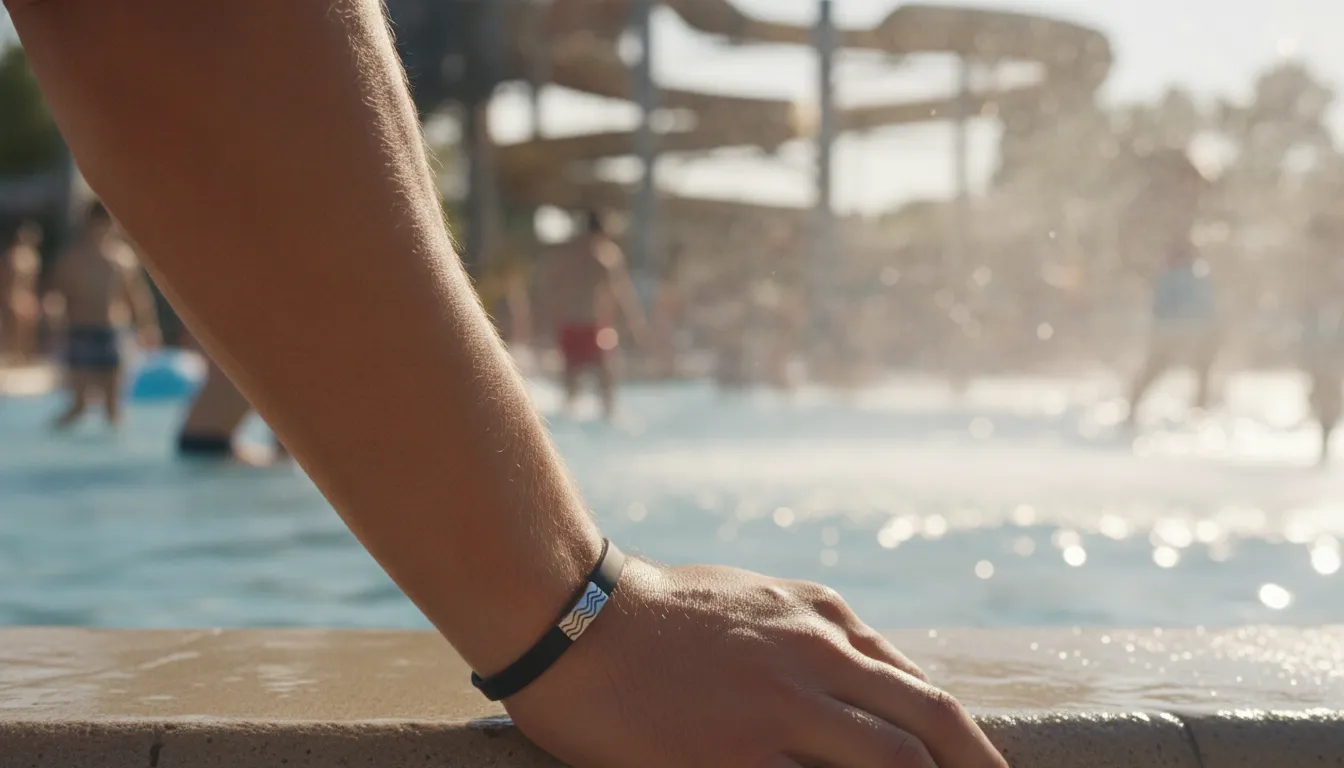
For more background on the company's approach, operators can review WAVE's company and aquatics-safety background and its swimmer-safety education resource. These pages support the larger point: drowning-detection technology is an added layer that works alongside trained people and established safety practices.
How should operators deploy and manage the system?
Successful deployment connects equipment to zones, alert ownership, training, realistic testing, and ongoing review. Treat the rollout as an operations project so each staff member knows what an alert means and what action comes next.
Deployment should be treated as an operations project rather than a one-time equipment delivery. The system must fit the facility map, staff assignments, opening routine, shift changes, and emergency action plan. A staged rollout also gives supervisors a way to find gaps before the park is busy.
1. Map zones and response routes
List each body of water and attraction, including wave pools, play structures, slide exits, lazy rivers, and quieter areas. Mark guard stations, supervisor positions, equipment storage, staff entrances, and likely response routes. Note where walls, sound levels, spray, or crowd density could affect communication.
2. Define ownership and escalation
Write down who receives the first alert and who takes over if that person is unavailable. Establish a simple acknowledgement process. The plan should distinguish a lifeguard entering the water, a possible swimmer submersion, a device test, and a technical alert. Clear terms help staff avoid treating every signal the same way.
3. Equip, train, and test
Assign devices by role and zone. Train staff on normal operation, alert meaning, acknowledgement, escalation, and reset. Test the system under realistic conditions, including background noise, attraction movement, shift changes, and the locations where responders will work. Record results and correct gaps before opening.
4. Review and maintain the process
Build checks into opening, closing, and handoff routines. Confirm that the lifeguard alert equipment is available, that wearables are assigned, and that staff know where replacements are stored. WAVE describes AquaSense wearables as having multi-year battery life without daily recharging, but that does not eliminate inspection, cleaning, testing, or replacement responsibilities.
- Map water zones and identify alert recipients.
- Write the response and escalation steps for each alert type.
- Train staff and test under realistic attraction conditions.
- Review readiness and response notes throughout the season.
A deployment plan is complete when a new team member can answer three questions: What does this signal mean? What is my first action? Who owns the next action? If the answer depends on informal knowledge, the process needs more work.
What does waterpark safety technology cost over time?
Evaluate the total operating cost, not only the subscription or equipment price. Include installation disruption, training, maintenance, monitoring, warranty coverage, staffing effort, and the expense of expanding coverage to additional attractions.
Budgeting should include more than the listed equipment price. Compare subscription or capital expense, installation disruption, maintenance, staff workload, monitoring, warranty coverage, training, and future expansion. A lower initial price may not be the lower operating cost if it requires extensive construction, downtime, or additional maintenance.
WAVE's current pricing page lists three term options for each of two bundles. The GUARDian Lifeguard Alert Bundle is listed at $199 per month for a 12-month plan. $169 per month for a 36-month plan, or $149 per month with 36-month AdvancePay. The GUARDian Swimmer Protection Bundle is listed at $399, $339, or $299 per month under those same plan structures.
The current pricing page also states that both bundles include 24/7 monitoring and a $0 deductible replacement warranty. Confirm current terms, included equipment, and coverage before budgeting because published pricing and facility requirements can change. A facility-specific quote should identify the equipment, service terms, monitoring, replacement coverage, and any exclusions.
Cost comparisons should also account for the size and operating model of the park. A seasonal facility may value portable deployment and a repeatable setup routine. A large multi-attraction park may need a phased plan that assigns coverage by zone and expands after staff have validated the workflow. Operators can review WAVE's product overview before requesting a configuration discussion.
How should operators measure whether the technology is working?
Measure readiness, alert receipt, acknowledgement, response steps, and recurring process gaps. These indicators show whether the safety layer is available and understood, without suggesting that any technology can guarantee a specific outcome.
Measurement should test the safety process, not manufacture a success claim. The purpose is to determine whether equipment is ready, alerts reach the right people, staff understand the response, and leaders use reviews to improve the program. Those indicators are useful even when no emergency occurs.
Track readiness and acknowledgement
Use opening checks and shift handoffs to record whether devices are present, assigned, operational, and clean. During drills, record whether the intended recipient notices the alert, acknowledges it, and follows the designated next step. A missed acknowledgement is a process issue to investigate, not evidence that a product guarantees an outcome.
Review patterns, not isolated numbers
Review recurring technical alerts, training questions, device availability, and response timing. Look for patterns by attraction, shift, day, and operating condition. Share findings with aquatics leadership and update training or assignments when the same gap appears repeatedly. Keep incident documentation aligned with the park's legal and safety requirements.
Leaders should also compare the technology's role with the broader plan. Verify that lifeguard coverage, scanning, rescue readiness, communication, and emergency procedures remain active. WAVE's wearable swimmer-safety guide can support further education, while the park's own drills and supervision standards remain the operational authority.
Frequently Asked Questions
Waterpark operators can use these answers to explain how wearable drowning-detection technology fits with lifeguard supervision, attraction-specific planning, and a broader emergency response program.
What is the best drowning prevention technology for waterparks?
The best fit is a layered system that matches the park's water conditions, attractions, staff workflow, and budget. Wearable detection may be useful where noise, movement, or visibility make another alert path valuable. Operators should compare detection, deployment, response ownership, maintenance, and training rather than selecting technology by label alone.
Are wearable monitors practical for wave pools and play areas?
They can be practical when the park assigns devices by zone, trains staff, tests alerts in realistic conditions, and maintains a clear response procedure. Wearables may add a direct signal in noisy or crowded areas. They support lifeguards and do not replace active supervision, scanning, rescue readiness, or emergency action procedures.
Can wearable technology work in dark or murky water?
WAVE describes its wearable approach as suitable for clear, dark, and murky water. Operators should still request a facility-specific demonstration and test the system in the actual attraction. Water conditions, signal range, device placement, staff position, and alert ownership should all be documented before relying on the technology as an added safety layer.
Does drowning prevention technology replace lifeguards?
No. Drowning-detection technology is an additional layer for supervised aquatic environments. Lifeguards and designated staff remain responsible for observation, confirmation, rescue response, and emergency procedures. Any vendor evaluation should make that relationship explicit. It should reject messaging that suggests a device can guarantee that every drowning event will be detected or prevented.
