
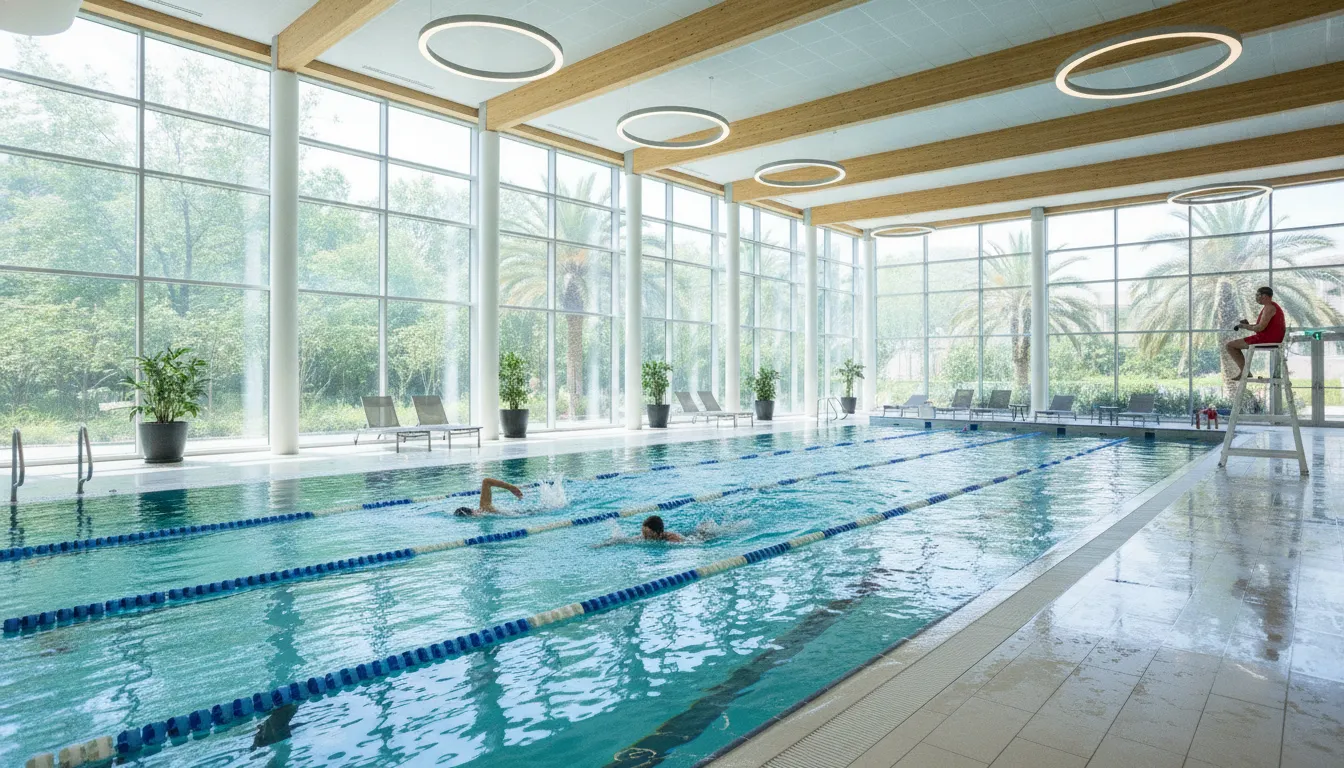
A fitness club pool rarely serves one type of swimmer at one pace. A lap swimmer may share the water with a beginner in a group class, while open swim brings changing ages, abilities, and attention levels into the same space. For facility managers, that mix makes consistent surveillance, clear response procedures, and documented safety practices essential.
Effective fitness club pool safety combines trained lifeguards, well-defined operating protocols, and an additional layer of drowning detection technology. WAVE supports this approach with wireless AquaSense swimmer wearables and facility alerts that help staff respond quickly when a swimmer remains submerged beyond a configured threshold. Without replacing lifeguard judgment or supervision.
The right strategy begins by recognizing how programming, traffic patterns, and staffing demands create different risks from one hour to the next. Understanding those conditions helps managers build a safety plan that protects members while supporting practical operations and responsible risk management.
Why Fitness Club Pools Face Unique Safety Challenges
Fitness club pools operate as shared spaces for very different activities and swimmers. A single pool may host lap swimming, water-based group exercise, lessons, rehabilitation, and family recreation within the same day. That mix creates a distinct fitness club pool safety profile that requires more than a standard set of posted rules.
Multiple activities create changing sightlines
Lane swimming brings steady, directional traffic, but not every swimmer moves at the same pace or remains equally visible. A competitive swimmer may stay submerged during a turn, while a beginner may pause unexpectedly or struggle near a lane rope. Group fitness classes add another layer: participants can have widely different comfort levels, stamina, and ability to respond when an instructor changes the exercise.
Those conditions can change quickly as classes begin and end. Instructors, lifeguards, and pool managers must account for activity transitions as well as the water itself. The risk profile is not identical to a public pool with one primary use or a water park organized around distinct attractions.
Peak membership creates staffing pressure
Fitness clubs often experience concentrated demand before work, after work, and on weekends. During these periods, several lanes, classes, and open-swim areas may be active at once. More swimmers can mean more visual targets, more movement, and more opportunities for a person in distress to blend into ordinary activity. High-volume crowds can also obstruct sightlines, particularly when swimmers cluster at walls or gather between programmed sessions.
Staffing the water appropriately is a practical challenge. A 2025 Recreation Management aquatic trends report found that 41.8% of aquatic facilities reported lifeguard staffing shortages. When staffing is tight, managers must make careful decisions about coverage, breaks, class schedules, and maximum occupancy without weakening supervision.
Trained lifeguards still need support
Lifeguards are essential, but human surveillance has limits in a busy, multi-use environment. WAVE's research notes that over half of child drownings involving children ages 5 to 14 occur at guarded facilities. A reminder that the presence of a lifeguard does not make every incident immediately visible. This finding should strengthen layered safety practices, not undermine professional lifeguarding.
For fitness clubs serving competitive swimmers, seniors, children, and members with varying abilities, the goal is coordinated protection: clear operating procedures. Appropriate staffing, active supervision, and tools that can help staff recognize a prolonged submersion or other emergency. An additional alerting layer can help a facility respond faster while keeping lifeguards at the center of the safety plan.
How Drowning Detection Technology Supports Fitness Club Pool Safety
For fitness club pool safety, WAVE adds a technology-supported alert layer to trained lifeguard coverage. AquaSense swimmer wearables monitor submersion, while the GUARDian Hub (w3000) and lifeguard tags help route alerts to the staff members who can respond. The system supports faster awareness without replacing active supervision.
Fitness clubs often serve lap swimmers, members in water-based classes, children, older adults, and swimmers with very different abilities in the same operating day. That mix can make continuous visual awareness more demanding, particularly when lanes are busy or activities overlap. WAVE is designed to give lifeguards another source of information to support the observation, communication, and response procedures already in place.
How the wearable and alert system works
AquaSense swimmer wearables use a submersion timer to identify when a swimmer remains underwater beyond a configured threshold. When an alert condition is detected, the system communicates through the GUARDian Hub (w3000), while lifeguard tags help notify the appropriate members of the team. This connected approach can help staff recognize a developing incident sooner than visual scanning alone, while keeping trained personnel responsible for evaluating the situation and taking action.
WAVE's wireless design does not require permanent construction or a facility closure for deployment. It is also designed to work in clear, dark, and murky water, so detection does not depend on a camera's view or ideal visibility. Learn more about how WAVE works in supervised aquatic environments.
A practical alternative to daily wearable charging
AquaSense wearables use a multi-year battery, so staff do not need to manage daily recharging as part of pool opening or closing routines. That distinction can simplify equipment readiness and reduce another point of operational friction when a club has multiple shifts, classes, or high member turnover.
Subscription-based deployment
The GUARDian Hub (w3000) is available through a subscription model. Facility leaders can review pricing, swimmer coverage, and operating procedures together when evaluating the right configuration for their pool. The goal is not to automate safety responsibility. It is to give lifeguards and managers an additional layer of protection that fits the way the club operates.
Key Components
A strong plan coordinates people, procedures, water quality, communication, and technology. That matters in fitness clubs because one pool may serve lap swimmers, children, seniors, beginners, and group classes within the same operating day. The most effective protocols adapt to those changing conditions while keeping safety responsibilities clear for every staff member.
Trained Staff and Regular Drills
Lifeguards and other pool staff need role-specific training, documented refreshers, and regular emergency drills. Practice should cover recognition, rescue, first aid, communication, chemical incidents, and the steps staff take when the pool must be cleared. Fitness club managers should also assess risks to workers and pool users, as recommended by the UK Health and Safety Executive's swimming pool guidance.
Clear Operating Procedures
Written procedures should define opening checks, supervision zones, bather loads, lane configuration, class transitions, weather responses, equipment inspections, and closure criteria. Use established guidance, such as HSE document F002, alongside applicable local requirements. Procedures should be easy to find and reviewed whenever the facility changes its programming, layout, or staffing model.
Water Quality Monitoring and Swimmer Education
Water management is part of pool safety, not a separate maintenance concern. CDC guidance recommends maintaining free chlorine at a minimum of 1 part per million and testing pH and disinfectant levels at least twice daily. With more frequent checks during heavy use. The Model Aquatic Health Code can supplement local codes. Staff should also teach members and parents practical behaviors, including staying out of the water when sick and not swallowing pool water.
Emergency Action Plans and Documentation
An emergency action plan should identify who calls for help, who manages the scene, who meets responders, how members are notified, and how the incident is documented. Run tabletop reviews and drills so the response is not dependent on one person. Accurate records of inspections, training, water testing, maintenance, and incidents support meaningful safety reviews and help managers identify recurring risks.
Detection Technology as an Additional Layer
Drowning detection technology can provide another alert pathway when visibility, crowding, or divided attention complicates surveillance. WAVE's wearable approach is designed to support lifeguards, not replace them, and its system records alerts and incident information that can contribute to audit trails. Explore fitness and athletic club safety solutions to see how detection can fit into a layered plan.
What Fitness Club Managers Should Look for in Pool Safety Equipment
Fitness club managers need pool safety equipment that strengthens active supervision without forcing a facility to redesign or close its pool. The right choice should fit existing operations, support staff response, and remain dependable when water conditions or swimmer activity change. It should also make financial sense for clubs balancing memberships, lessons, lane swimming, and group programming.
When evaluating fitness club pool safety options, compare the installation burden, operating model, water visibility requirements, and alert pathway, not just the headline feature list. WAVE and camera-based systems take different approaches to drowning detection, so the practical fit depends on the facility's pool, budget, and ability to undertake construction.
| Evaluation factor | WAVE wearable system | Camera-based systems, such as AngelEye or Poseidon |
|---|---|---|
| Installation and disruption | Wireless equipment can be deployed in an existing pool without permanent construction, making it practical for clubs that cannot close for a major installation. | Typically requires camera installation and related construction or infrastructure work, which can create scheduling, access, and closure concerns. |
| Water conditions | AquaSense swimmer wearables are designed to support detection in clear, dark, or murky water, rather than relying on an unobstructed camera view. | Camera-based detection depends on image visibility and is generally best suited to clear-water pools with an appropriate field of view. |
| Ongoing cost | WAVE's GUARDian Hub (w3000) is available through a subscription model, helping avoid a large upfront capital purchase. | Camera systems generally involve higher upfront costs because of cameras, installation, infrastructure, and commissioning. Request a facility-specific quote before comparing total cost. |
| Battery and daily operations | AquaSense wearables use a multi-year battery, so staff do not need to recharge competing-style wristbands every day. | Fixed cameras do not require swimmer wearables, but the facility must maintain the installed camera and monitoring infrastructure. |
| Standards and alerts | Wearable alerts can notify staff within seconds when a swimmer remains submerged beyond the configured threshold, adding another layer to lifeguard supervision. | Some camera-based systems reference ISO 20380:2017, the international standard for drowning detection systems in non-domestic pools larger than 150 m². AngelEye describes alarms within 10 seconds on configurable devices. Review the ISO 20380:2017 standard. |
No technology replaces trained staff, established scanning practices, or emergency procedures. For an existing fitness club pool, however, a wireless system can reduce implementation friction while giving lifeguards an additional alert channel. Managers can review WAVE's approach and assess which solution best matches their pool layout, water conditions, operating schedule, and improvement budget.
Liability and Risk Management for Athletic Club Pools
For an athletic club, pool safety is both an operational responsibility and a risk management priority. A suitable risk assessment helps managers identify hazards affecting workers and members, then determine which controls, procedures, and resources are needed to address them. The UK Health and Safety Executive states that swimming pool operators are legally required to protect the health and safety of workers and pool users. Making documented oversight an important part of responsible operations.
Key takeaway: Strong liability management combines written procedures, trained staff, regular audits, and accurate incident records. These controls do not eliminate risk, but they demonstrate that the club takes a proactive, organized approach to protecting swimmers and responding when conditions change.
Document protocols and train staff consistently
Written protocols should explain how the club manages supervision, lane use, group classes, swimmer capacity, emergency response, equipment checks, and communication between the pool deck and management. Staff training should be documented, refreshed regularly, and tailored to the club's actual programs and pool layout. Managers should also record safety audits and corrective actions, including who completed the action and when.
This documentation helps create consistency across shifts and makes it easier to identify gaps before they contribute to an incident. It also supports a clearer response when an insurer, regulator, member, or legal representative asks how the facility managed a known hazard. Athletic clubs can review additional guidance through the Health and Safety Executive's swimming pool guidance.
Use incident records to improve the safety system
Every event that affects pool safety should be recorded promptly, including rescues, medical responses, false alarms, equipment faults, near misses, and temporary closures. A complete incident record should capture the time, location, conditions, staff involved, actions taken, notifications made, and follow-up required. The goal is not merely to preserve a paper trail. It is to identify recurring patterns and improve procedures, staffing, training, and equipment decisions.
Drowning detection technology can add an additional layer of accountability through audit trails and incident documentation. WAVE is designed to support lifeguards, not replace them, while giving facility leaders more information to review after an alert or event. The stakes are significant: a YMCA and Red Cross 2023 study reported that 68% of aquatic facilities experienced a pool closure or legal action following a drowning. Athletic club leaders can learn more about fitness and athletic club safety solutions as part of a broader, documented risk management plan.
Frequently Asked Questions
What should a fitness club pool safety plan include?
A practical plan should cover daily water and equipment checks, clear rules for lane swimming and group classes. Lifeguard positioning, emergency response procedures, staff training, incident documentation, and regular drills. Managers should also review the plan when pool programming, staffing, or facility layout changes.
Can drowning detection technology replace lifeguards at a fitness club?
No. Drowning detection technology is an additional layer of protection and a force multiplier for trained lifeguards. AquaSense swimmer wearables can alert staff when a swimmer remains submerged beyond a configured threshold, helping the team respond quickly while normal supervision and emergency procedures remain essential.
What features should managers compare when evaluating pool safety equipment?
Evaluate detection method, alert speed, coverage, water-condition performance, staff workflow, maintenance requirements, and installation demands. A wireless system that works in clear, dark, and murky water and does not require permanent construction can be easier to deploy as programming and pool operations evolve.
How can a fitness club add safety technology without a major construction project?
Look for plug-and-play equipment that integrates with existing operations rather than requiring cameras, wiring, or structural changes. WAVE's GUARDian Hub (w3000), GUARDian Lifeguard Alert Bundle, and AquaSense swimmer wearables are designed to add alerting capability while supporting the facility's existing lifeguard team and procedures.
How should managers document pool safety improvements for risk management?
Maintain records of inspections, staff training, drills, incidents, corrective actions, equipment testing, and policy reviews. When adding technology, document its intended role, alert response process, maintenance schedule, and staff acknowledgment. This creates a clearer operational record without suggesting that any single tool eliminates risk.
Schedule a Free Consultation for Your Fitness Club
A thoughtful review can help your team consider how wearable drowning detection technology may fit alongside existing supervision and pool safety protocols. Schedule a free consultation with WAVE to discuss your facility's needs and learn how an additional layer of protection can support staff response.
