
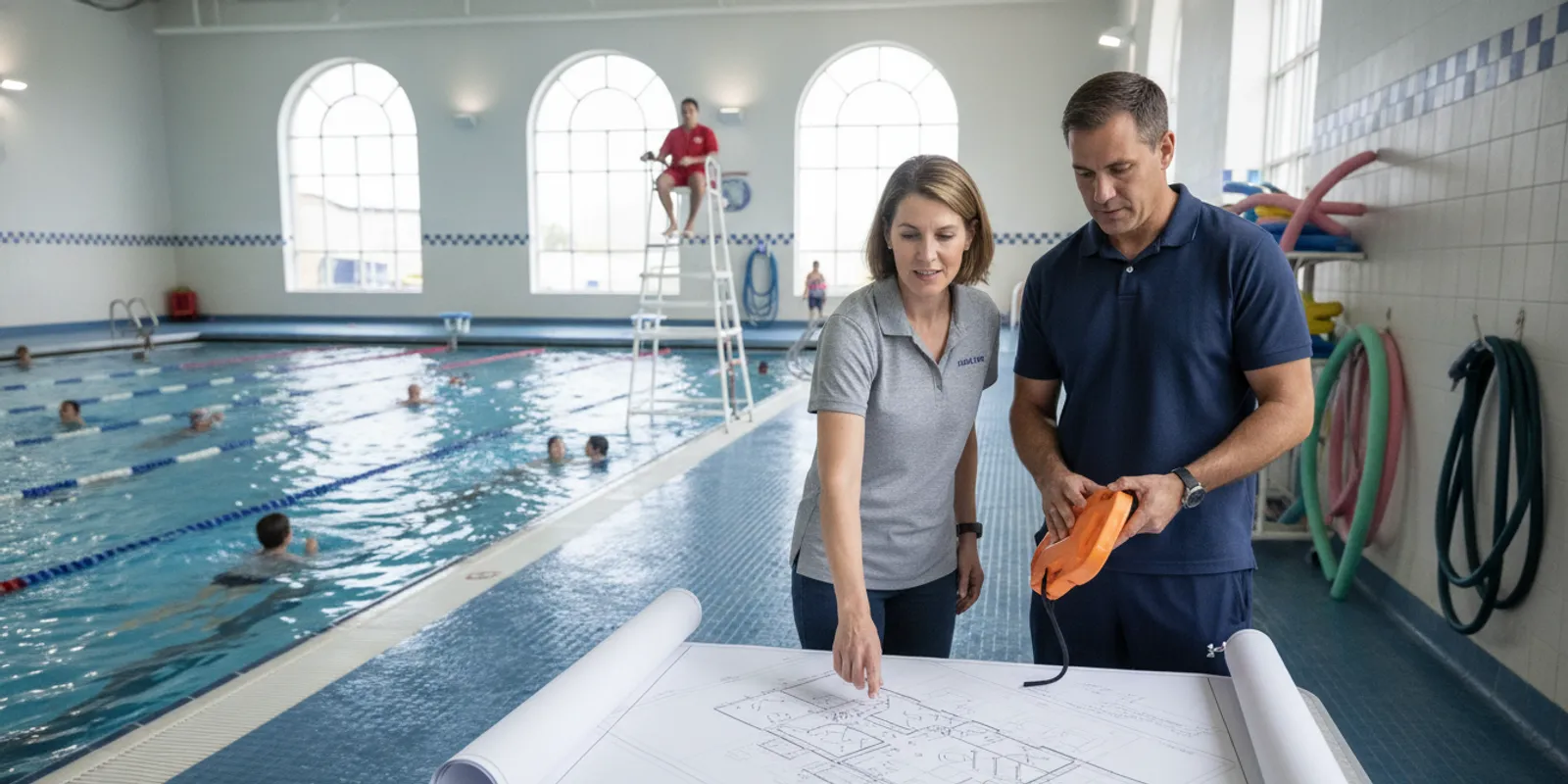
A well-prepared request for a pool safety equipment quote helps an aquatic facility get a proposal that fits its actual environment, operating practices, and budget process. Before comparing pool safety products, gather the details a provider needs to understand where swimmers use the water, how staff respond, and what a useful alert should do. This checklist is for aquatics directors, facility operators, and institutional buyers planning safety equipment for a supervised facility.
What should a facility clarify before requesting a pool safety products quote?
A useful quote starts with a clear description of the decision, not a product wish list. Identify the sites and people involved, the safety concern you are addressing, and how the proposal will be evaluated. That context helps a provider recommend an appropriate scope and gives your team a fair basis for comparing options.
Begin by agreeing internally on what the purchase process needs to accomplish. Are you exploring an additional alert layer for one pool, evaluating options for several locations, or preparing information for an upcoming budget review? A quote request can cover more than one goal, but say which is most important so the response can address it directly.
Record who will review the proposal and who will use the equipment day to day. Aquatics leadership, facility operations, risk management, procurement, IT, and finance may each have different questions. Naming the reviewers early can prevent a late-stage request for missing technical, service, or financial details.
- Decision owner: Identify the person coordinating the request and the people who approve or influence a purchase.
- Scope: List the facility or facilities under consideration, including any phased or future expansion plans.
- Purpose: Describe the operational need in plain terms, such as improving staff awareness of a swimmer alert or evaluating another layer of protection.
- Timing: Note the date by which you need a proposal, any budget-cycle deadlines, and the preferred deployment window.
- Constraints: State procurement rules, contract review requirements, available operating or capital budget pathways, and any approval steps.
Keep the request focused on the facility’s needs rather than assuming a particular technology is right before the evaluation. For background on the range of considerations, see this guide to evaluating commercial pool safety equipment. Use it as a separate, broader comparison resource; this checklist concentrates on preparing the information a provider needs to quote your site.
Which facility and water details belong in the request?
Describe how the facility operates under real conditions. Include water environments, operating schedules, swimmer groups, and the layout that may affect equipment coverage or staff alerts. Clear site information helps a provider identify assumptions, ask better follow-up questions, and explain whether a proposed system is suited to the setting.
A short written site profile is often more useful than a general description such as “large pool.” Include the type of water environment and any conditions that could affect visibility, communication, or equipment placement. For an outdoor or natural-water venue, explain what makes the setting different from a conventional indoor pool.
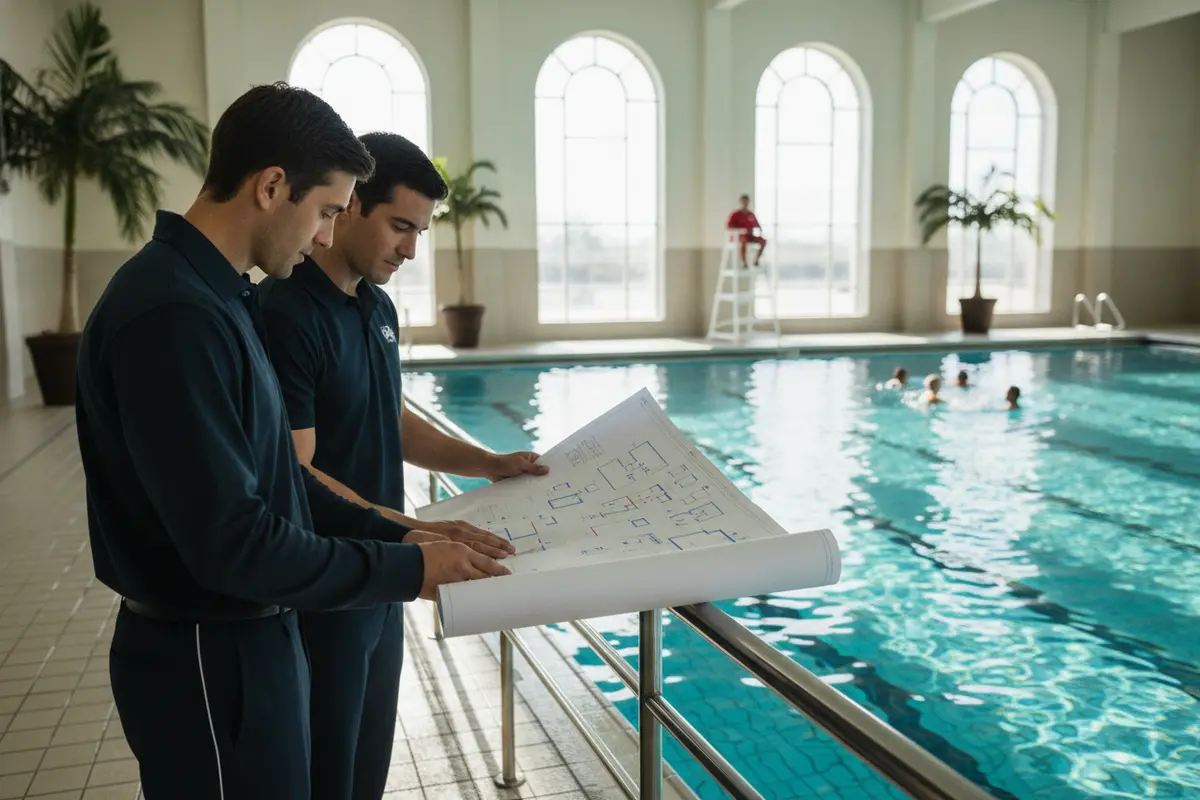
Share relevant drawings, dimensions, or a simple marked-up map if available. Identify pool basins, entry points, lifeguard stations, shared spaces, and the locations where staff typically monitor or respond. A map does not need to be a technical blueprint. It should make the layout understandable and help everyone discuss the same areas.
- Facility type and number of water areas in scope.
- Indoor, outdoor, or natural-water setting, and seasonal operating patterns.
- Approximate dimensions, depth zones, and any connected or separated areas.
- Water clarity or other conditions that are typical, as well as conditions that vary by season or activity.
- Normal operating hours, peak periods, program schedules, and any planned closures or renovations.
- Common swimmer groups and activities, such as lessons, open swim, camps, or team practice.
- Known connectivity, power, storage, or equipment-location considerations that the provider should assess.
Distinguish confirmed facts from estimates. If exact dimensions or typical attendance are not available, label the information as approximate and offer to confirm it during a site discussion. Avoid sharing personal swimmer information; a quote generally needs operational patterns and group types, not identifiable records.
Rules and facility requirements can vary by jurisdiction, so confirm applicable obligations with the relevant state and local authorities. For example, the official New Jersey state website is a government starting point for state-level information; use the authority for your own location when checking local requirements.
Facility conditions matter when considering different approaches. Camera-based equipment may have installation and visibility requirements, while wireless wearable systems have different deployment and operating considerations. For a closer look at WAVE’s wearable approach and its role in supervised settings, review the GUARDian Hub system information and WAVE's wearable detection overview. Ask each provider to explain how its proposed equipment fits the conditions you have described, rather than relying on a general product claim.
How should you explain staffing and alert workflows?
Describe what staff do before, during, and after an alert. Explain who supervises each area, how a message should reach the right people, and what escalation looks like under your current procedures. Technology is an added support layer, so a proposal should fit, not replace, the facility’s lifeguard coverage, emergency action plan, and staff responsibilities.
Providers need to understand how your team is organized, not just how many employees are on site. Outline the roles responsible for active supervision, who leads an emergency response, and which staff members may need to receive an alert. Do not assume the provider knows how your facility handles a shift change, a busy program, or an event with several water areas in use.
Map the alert path from detection to action. For example, state whether the initial notification should reach a lifeguard, an aquatics supervisor, or another designated responder, and who should be informed if the first person is unavailable. Describe the communication methods already used by staff and any limitations that affect response.
| Workflow detail. | What to provide. | Question to resolve. |
|---|---|---|
| Supervision model. | Staff roles, zones, and how coverage changes across programs or shifts. | Who is responsible for each water area at different times? |
| Alert recipients. | Roles or positions that should receive an alert. | Who needs to know first, and who is the backup? |
| Notification method. | Existing radios, wearable alerts, facility announcements, or other channels. | How can the alert reach staff without creating confusion? |
| Escalation. | Current procedure when an alert is not acknowledged or a response is underway. | Who coordinates follow-up, and how is the incident documented? |
| Operating variation. | Lessons, camps, events, breaks, and other changes to normal operations. | Does the process remain clear when staffing or swimmer use changes? |
Use your facility’s approved emergency action plan and policies as the authority for response steps. A technology proposal should explain how its alerts fit into those procedures; it should not create a parallel response plan or imply that equipment can make the response on behalf of staff. If the facility needs to update its plan, handle that as a separate operational task with the appropriate leaders.
For WAVE, approved terminology includes the GUARDian Hub (w3000), lifeguard tags, AquaSense swimmer wearables, and Hub Management Software (HMS). A wearable, wireless system is intended to support staff through alerts, including alerts tied to prolonged submersion or lifeguard water entry. Explore the lifeguard equipment and alert options and swimmer equipment as you decide which workflows to discuss with a provider.
What pool safety products scope and requirements should you list?
Turn the site profile and workflow into a scope that providers can respond to. Identify locations, user groups, alert recipients, and the capabilities you want evaluated, while separating required needs from preferences. This makes the quote more specific without locking your team into a solution before it has reviewed the evidence.
Describe what the proposed equipment would cover and who would interact with it. If the request includes multiple pools or locations, distinguish the needs of each rather than treating them as identical. A consistent scope also makes it easier to see whether each quote includes comparable equipment and services.
List requirements in two columns: essential and preferred. Essential items are conditions the solution must meet to be considered. Preferred items could improve usability, but may not be deal-breakers. This distinction helps providers answer accurately and gives internal reviewers a transparent way to assess trade-offs.
- Coverage: Which water areas, swimmer groups, and staff functions should be included in the proposal?
- Detection and notification: What types of events or alerts are relevant to your workflow, and who should receive them?
- Operating conditions: What water, weather, lighting, or seasonal conditions must the equipment accommodate?
- Deployment: Are there constraints involving construction, permanent fixtures, facility access, or keeping areas in operation?
- Wearability and upkeep: What comfort, sizing, storage, cleaning, battery, or charging considerations should be addressed?
- Management: What information should authorized staff be able to review, and who will administer access?
- Expansion: Is a phased rollout or adding additional areas later a consideration?
Avoid setting quantities based on guesswork. Provide your best estimate of swimmers, staff, and areas in scope, then ask the provider to state the assumptions behind the proposed configuration. If activity varies widely, share a typical range and the busiest operating scenario you want the proposal to account for.
Use the commercial pool safety products overview to identify relevant product areas and terminology. You can also explore GUARDian Lifeguard Alert Bundle details and the GUARDian Swimmer Protection Bundle. These pages can help you frame questions; the right scope depends on the facility’s conditions, workflows, and evaluation criteria.
Which training, support, and service details should the quote cover?
Equipment alone is not the whole proposal. Ask what onboarding, staff instruction, technical support, maintenance guidance, software, warranty, and service response are included, and what the facility must provide. Clear answers let your team assess the practical effort and ongoing responsibilities alongside the equipment itself.
Clarify who will set up the system, what the facility must do before deployment, and how staff will learn their roles. Ask whether training is intended for administrators, lifeguards, supervisors, or all of these groups, and how new staff will be oriented later. A short demonstration can show the interface, but it does not replace facility-specific training and procedures.
Ask providers to describe ongoing service in concrete terms. The response should distinguish automated system monitoring from human support, list support hours and contact methods, and explain how issues are prioritized. Request the warranty terms in writing, including what is covered, any deductible or replacement conditions, and how a service request is started.
- What is included in setup, configuration, and onboarding?
- Which staff roles receive training, and what materials or refresher options are available?
- What equipment, software, connectivity, storage, or facility resources are required?
- How are routine checks, cleaning, charging or battery care, and replacements handled?
- What monitoring and technical support are provided, and during which hours?
- What are the response expectations for different kinds of support requests?
- What warranty applies to each component, and what exclusions or return conditions apply?
- How are software changes communicated, and what changes might require staff orientation?
For equipment that uses swimmer wearables, ask how sizing, assignment, collection, cleaning, storage, and maintenance fit into your daily routine. WAVE’s content describes AquaSense wearables as non-tethered and designed with a multi-year battery rather than daily recharging; ask the provider to confirm current specifications and explain care requirements for your use case. Compare these practical tasks, not only the headline features.
Review the provider’s frequently asked questions and support information as part of your due diligence. Record any service questions that remain unanswered and ask for them to be addressed in the proposal or a follow-up discussion.
How can you compare quotes on a like-for-like basis?
Compare what each proposal will deliver, what the facility must do, and what it will pay over the stated term. Do not rank options by one number or feature alone. A consistent comparison should make scope, service, assumptions, operational fit, and unresolved questions visible to decision-makers.
Build a simple evaluation matrix before the proposals arrive. Give each provider the same site information and questions, then record what is included and what is excluded. If a proposal uses assumptions that differ from yours, ask for a revision or a written explanation before comparing totals.
| Comparison area. | What to record for each proposal. | Why it matters. |
|---|---|---|
| Scope and configuration. | Areas, users, equipment, quantities, and any optional items. | Shows whether proposals address the same operational need. |
| Site fit and deployment. | Installation or deployment steps, prerequisites, timing, and disruption. | Reveals facility work and scheduling considerations. |
| Staff workflow. | Alert recipients, notification path, training, and alignment with procedures. | Connects features to how the team actually operates. |
| Service and warranty. | Support availability, service expectations, coverage, and exclusions. | Clarifies what happens after initial setup. |
| Price and contract. | Recurring and one-time charges, term, payment schedule, and renewal conditions. | Helps finance compare the full commitment on consistent terms. |
| Open assumptions. | Unconfirmed quantities, conditions, or dependencies. | Prevents an estimate from being mistaken for a complete commitment. |
Ask for a clear breakdown of recurring charges, equipment or setup charges, contract term, renewal process, and any optional components. The price page can be a starting point for understanding WAVE subscription information, but request a current proposal for your specific scope and confirm all figures and terms directly. Do not compare a monthly subscription with a one-time purchase without noting what equipment, service, software, and support each includes.
Include an operational fit review alongside the financial review. Ask staff representatives to explain which workflow details they understand, which seem burdensome, and what additional training or procedure work may be needed. A product demonstration can help answer questions about use, but the decision should also account for the written scope, service terms, and the facility’s own safety policies.
How should you turn the checklist into a quote request?
Send a concise request with a site profile, marked-up layout if available, staffing and alert workflow, requested scope, evaluation questions, and decision timeline. Ask the provider to state assumptions, exclusions, service details, and pricing terms. That gives reviewers a usable proposal and creates a clear path for follow-up.
Once your team has gathered the information, write a short cover note that tells the provider what response you need. Attach only materials relevant to the scope, and label estimates or unknowns clearly. A well-organized request need not be long; it should be complete enough to prevent avoidable back-and-forth and make the proposal reviewable.
A request can follow this outline:
- Facility overview: Identify the organization, site, water areas, operating patterns, and intended scope.
- Site conditions: Provide available dimensions, a layout, relevant water conditions, and any deployment constraints.
- Staff workflow: Explain supervision roles, alert recipients, existing communication channels, and relevant procedures.
- Requested response: List must-have requirements, preferences, potential configurations, and items to price separately.
- Evaluation questions: Request details about training, support, warranty, deployment, assumptions, and contract terms.
- Process and timing: State the response deadline, decision process, budget review timing, and preferred next step.
Keep a copy of the request and use the same version when speaking with each provider. If a site visit or demonstration is appropriate, invite the relevant operational stakeholders and prepare questions in advance. Afterward, add verified answers to your comparison matrix and identify any item that needs clarification before approval.
If you are ready to discuss a facility’s needs and possible configurations, request a conversation with WAVE. You can also use the swimming pool safety tools guide as a further reference while assembling your internal evaluation.
Frequently Asked Questions
A strong request makes it easier for providers to respond to the same facility needs and for your team to evaluate the results. The questions below cover common gaps: what to send, which quantities to estimate, how to compare options, and how to keep alert technology aligned with staff responsibilities.
What information should I send with a pool safety equipment quote request?
Send a facility profile, water-area details, any available layout or dimensions, operating patterns, staffing and alert workflows, requested scope, and decision timeline. Include questions about deployment, training, support, warranty, and contract terms. Mark estimates and unknowns so they are not mistaken for confirmed details.
Should we request exact equipment quantities before a site review?
No. Share your best estimates of swimmers, staff, locations, and busy operating scenarios, then ask the provider to state the assumptions behind its proposed configuration. Confirm quantities during follow-up rather than treating an early estimate as final.
What should we compare besides price?
Compare scope, site fit, deployment, staff workflows, training, support, warranty, contract terms, exclusions, and assumptions. Make sure each provider is responding to the same facility needs before comparing costs.
Should technology replace lifeguard coverage or emergency procedures?
No. Drowning-detection technology is an additional layer of support in supervised aquatic environments. It should fit the facility’s lifeguard responsibilities and approved emergency action plan, not replace either one.
What service details should a quote include?
Ask about setup, onboarding, staff training, support hours, service response expectations, routine care, software, warranty coverage, exclusions, and how to request assistance. Get material terms in writing so reviewers can assess the full commitment.
With the right facility information in hand, your team can request a proposal that is easier to review, compare, and connect to real operating needs. Keep trained staff, established procedures, and an additional layer of technology working together in the safety plan.
