
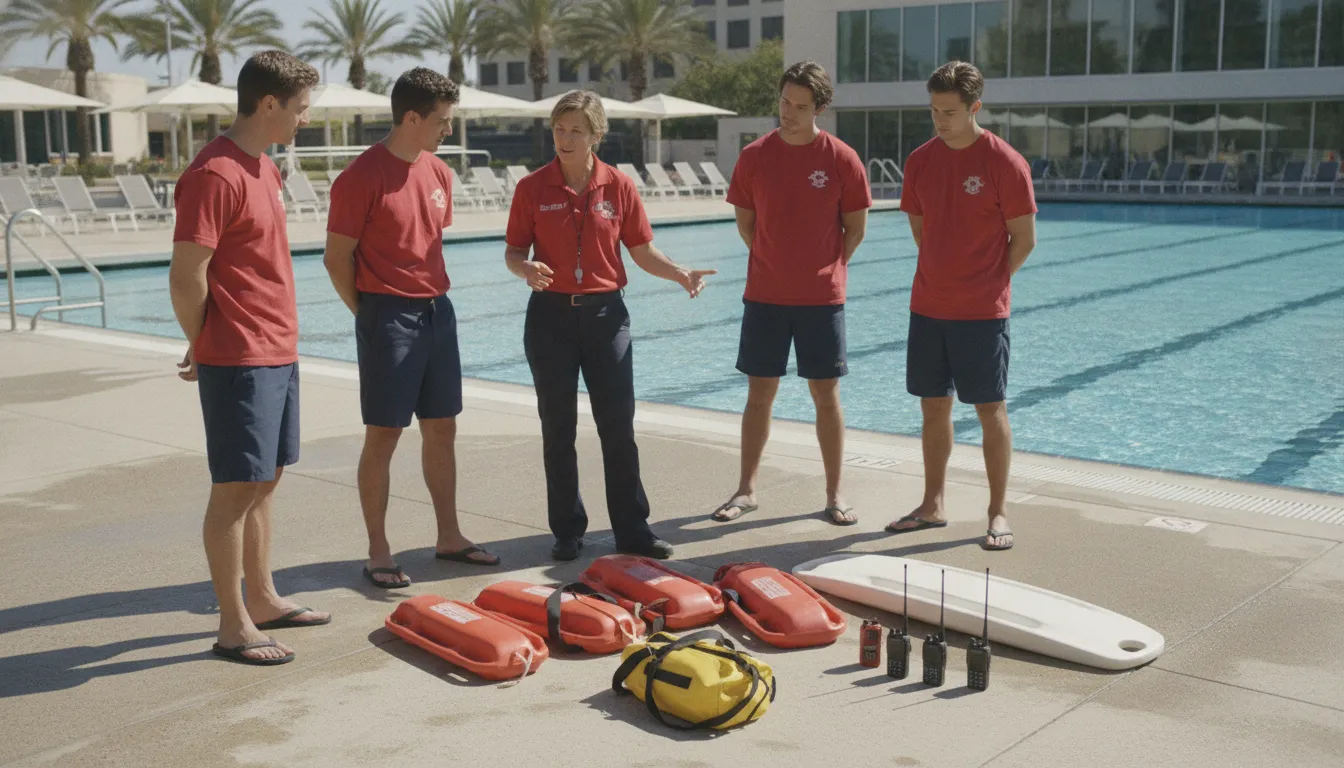
Pool safety decisions rarely come down to choosing one device. Aquatic directors must coordinate trained supervision, clear communication, emergency readiness, maintenance, and tools that help staff recognize and respond to changing conditions. The strongest approach is a layered program built around the way people actually use each pool, deck, and monitoring zone.
A practical swimming pool safety tools program combines active lifeguard supervision with emergency equipment, reliable staff communication, water-quality and maintenance controls, and detection technology that adds another layer of protection. No technology replaces lifeguards, training, emergency action plans, or timely staff response.
Start by mapping the risks and workflows your team manages every day. That makes it easier to evaluate which tools improve visibility, shorten communication paths, support consistent readiness, and produce useful records without creating new distractions for staff.
What should a swimming pool safety tools program include?
A strong program is layered because no single tool addresses every risk in a supervised aquatic environment. Start with people and procedures, then add equipment and detection that help staff notice hazards, communicate quickly, and respond consistently. The CDC recommends continuous, close supervision, and notes that drowning can happen in seconds and is often silent. Active supervision remains the foundation of pool safety.
Supervision, training, and communication
Qualified lifeguards need clear zones, defined scanning responsibilities, and a process for handing off coverage without gaps. Training should include recognizing a swimmer in distress, initiating the facility's emergency action plan, and performing CPR. Staff should also understand how to use radios, public-address systems, alarms, and any wearable or facility alert correctly. Distractions matter: the CDC advises adults watching children near water to avoid phone use and other activities that divide attention. Tools should reduce communication friction, not create confidence that technology can replace lifeguards or active monitoring.
Emergency equipment and access controls
Keep rescue equipment visible, accessible, and inspected at the poolside. Depending on the facility's emergency plan, that may include life rings, throw ropes, first-aid supplies, CPR equipment, and an AED. Barriers, self-closing or self-latching gates, depth markers, and clear rules can help control access and reduce preventable hazards. Covers, alarms, barriers, skimmer guards, and cover plates may address different risks when used together, but each item needs an owner and a documented inspection routine. A tool that is blocked, missing, damaged, or unfamiliar during an emergency is not ready for service.
Water quality, maintenance, and detection
Water-quality controls belong in the same operating system. The CDC identifies chlorine or bromine disinfection and pH as the first defense against swimming-related germs. It recommends checking disinfectant levels and pH at least twice daily, more often during heavy use. Log those checks alongside equipment inspections, cleaning, and corrective actions. Detection technology can add another layer by helping alert staff to a possible prolonged submersion or water entry. It still requires trained staff to assess the alert and respond. A complete program therefore connects monitoring, escalation, emergency equipment, maintenance, and post-incident review rather than treating detection as a standalone purchase.
A complete swimming pool safety tools program combines active supervision and training with communication, emergency readiness, water-quality controls, access management, and detection. Each layer should have a defined staff response, inspection routine, and accountable owner.
How do supervision and staff workflows shape tool selection?
The right swimming pool safety tools should fit the way staff actually supervise the facility. Start by mapping each pool, deck, entry point, and adjacent activity area into clear monitoring zones. Then identify who owns each zone during open swim, lessons, camps, competitions, breaks, and shift changes. A tool that produces an alert without a defined responder can add noise instead of improving readiness.
Continuous, close supervision remains the foundation. The CDC advises facilities to provide continuous and close supervision to swimmers, and it identifies lack of close supervision as a drowning risk factor. Selection should therefore reinforce scanning, zone coverage, and clear handoffs rather than encourage staff to watch a dashboard instead of the water.
Consider the distractions that compete with observation. Phone use, reading, glare, crowd noise, guest questions, and movement between zones can all affect how consistently staff maintain attention. Equipment should make the next action obvious and support discreet communication when appropriate. If an alert is audible only at one station, or if every notification sounds like an emergency, staff may miss the message that matters. Ask vendors to demonstrate how alerts reach the assigned responder and what happens when that person is occupied.
Workflows also determine whether a system is useful during drills and real incidents. Define who receives the first alert, who confirms the condition, who clears the zone, who retrieves emergency equipment, and who contacts additional support. Practice those handoffs during normal staff training. Staff should learn to recognize and respond to a swimmer in distress and perform CPR; technology can support that response, but it cannot replace training, judgment, or an emergency action plan.
Finally, choose tools that create accountable records without turning safety into paperwork. Supervisors should be able to review coverage, alert response, equipment readiness, and drill findings, then assign follow-up actions. Barriers and alarms may address access risks, while monitoring tools can add awareness, but these layers work best when their purpose and response owner are documented. WAVE is designed as another layer of protection for supervised aquatic environments, supporting lifeguards and staff rather than replacing them.
Supervision determines tool value: map zones, assign responders, rehearse handoffs, and select technology that strengthens active lifeguard coverage instead of competing with it.
Which communication and emergency tools deserve priority?
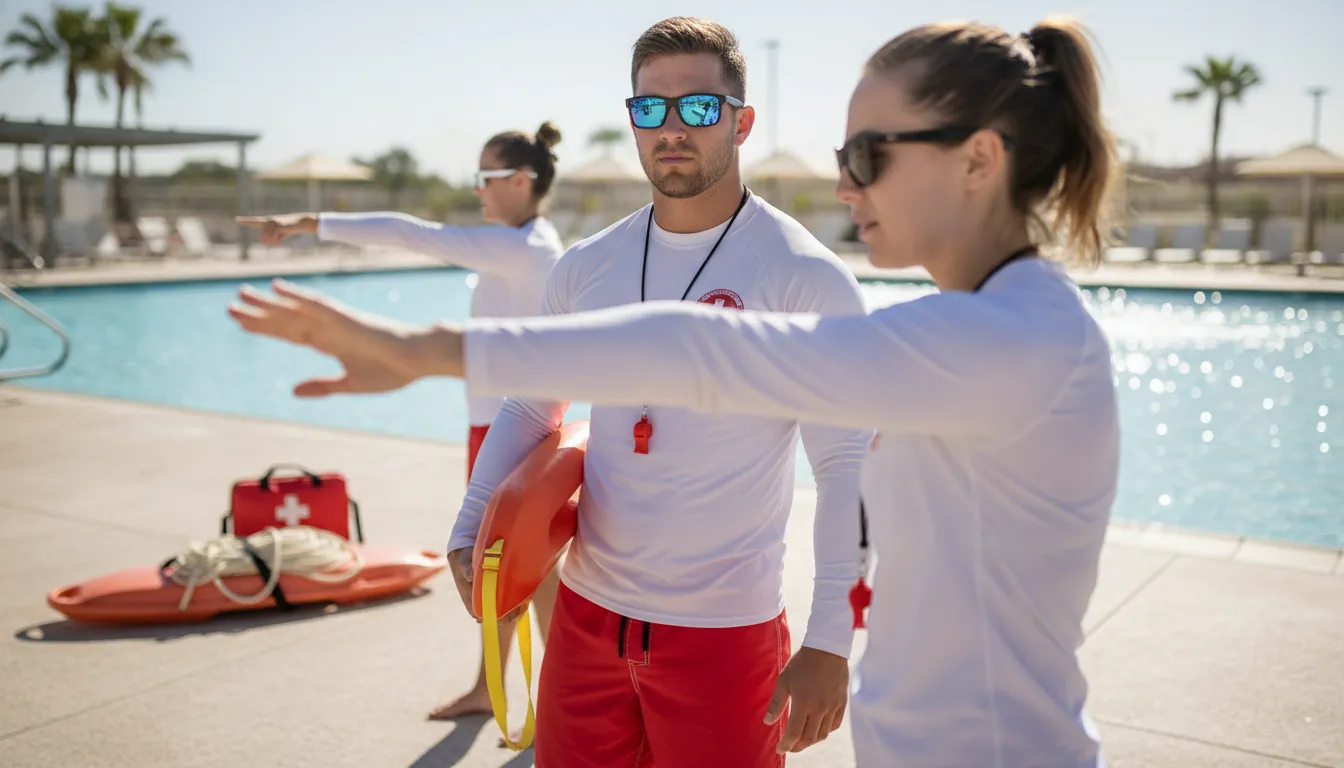
Prioritize tools that help staff recognize a problem, communicate it clearly, and begin the right response without unnecessary delay. Rescue equipment should be visible, accessible, and positioned for the pool's layout. Life rings and throw ropes can help staff assist a swimmer in distress without immediately requiring a rescuer to enter the water. Equipment only helps when employees know where it is and how to use it. Lifeguard alert equipment can add another communication layer to that physical response plan.
Build the emergency action plan around specific roles. It should identify who enters the water, who clears the pool, who calls emergency services, who meets responding units, and who communicates with supervisors or families. Practice those handoffs under realistic conditions, including loud environments and multiple monitoring zones. The CDC recommends that staff learn to recognize and respond to a swimmer in distress and perform CPR. CPR skills may help during the interval before paramedics arrive, so training and recurring drills deserve the same priority as the equipment itself.
Make alerts audible, actionable, and appropriately escalated
A radio, phone, public-address system, or dedicated alert platform is only useful if the intended responder receives the message and understands what to do next. Evaluate coverage, battery readiness, channel discipline, and backup communication methods. In a busy facility, alerts should distinguish a routine operational message from a possible swimmer emergency. Staff also need a defined escalation path when the first recipient does not acknowledge the alert.
WAVE's model illustrates one possible layered approach: discreet vibrating notifications for staff, followed by spoken-word facility alerts and sirens or visual indicators when escalation is needed. This kind of progression can support a measured response while increasing visibility when immediate coordination is necessary. It does not replace active supervision, an emergency action plan, trained responders, or judgment at the scene.
Finally, inspect the response environment itself. Keep rescue tools unobstructed, confirm first-aid and CPR supplies are accessible, and test radios or alert devices before opening. Document drills, missed acknowledgments, dead batteries, and areas where sound or glare interferes with communication. Those records show whether a tool supports the workflow in practice, not merely whether it is present.
Priority belongs to emergency tools that connect trained people to a clear response: visible rescue equipment. Reliable communication, accessible CPR resources, and an escalation plan tested in the facility's real conditions.
How should facilities evaluate detection technology?
Detection technology should be evaluated as one layer in a broader safety program, not as a replacement for lifeguards, active supervision, training, or an emergency action plan. Start by defining the event the system must help staff recognize, such as a swimmer remaining submerged too long or a lifeguard entering the water. Then map how that signal reaches the right people, how they respond, and how the facility documents the event.
That operational view matters because drowning can happen quickly and quietly, according to the CDC. A useful system should support continuous, close supervision by helping staff notice a developing problem and coordinate a response. It should reduce the distance between detection and action without creating the impression that technology can make a supervised aquatic environment risk-free.
Wearable and wireless systems
Wearable systems use devices associated with swimmers or lifeguards, while wireless communications connect alerts to staff and facility notification points. When assessing this approach, ask whether the devices fit the facility's swimmer programs, whether staff can recognize and respond to alerts quickly, and whether the alert path works across the areas that need coverage. Also review how the system handles equipment tracking, battery notifications, permissions, configuration, and activity records.
WAVE combines AquaSense swimmer wearables, lifeguard tags, a GUARDian Hub, and cloud-based monitoring software. Its documented alert model can move from discreet vibrating staff notifications to spoken-word alerts, sirens, and LED indicators if a condition continues. The purpose is escalation and coordination, not automatic rescue. Facilities can review wearable swimmer detection and how the GUARDian system works to understand the workflow and ask more precise implementation questions. Decision-makers can also review current WAVE subscription options when comparing deployment approaches.
Fixed cameras and site conditions
Camera-based detection deserves a different set of questions. Identify where cameras would need to be mounted, whether installation affects construction schedules or pool operations, and how lighting, glare, water clarity, and viewing angles may affect the intended use. A fixed system may also require a facility to define who monitors the feeds, how alerts are acknowledged, and how blind spots are handled.
Wireless wearable approaches can be worth considering when a facility needs flexible deployment across indoor or outdoor areas, multiple bodies of water, or changing programs. WAVE states that its wearable system is designed for clear and murky water and can deploy without permanent construction. Confirm current capabilities, coverage, and operating requirements during evaluation rather than assuming that any system works equally well in every environment.
Finally, test the technology with the people who will use it. Run realistic drills, include noise and normal staff movement, and record response times, missed alerts, false alarms, and maintenance steps. The strongest choice is the one that fits existing supervision and emergency workflows while adding a practical layer of awareness.
Detection technology is most useful when it gives trained staff another timely signal to support supervision, communication, and response. Evaluate wearable and fixed systems against actual site conditions, staff workflows, and maintenance capacity.
What role do water quality and maintenance tools play?
A safety-tool review should extend beyond alarms, rescue equipment, and staff communication. Water quality and operational readiness affect whether a facility can open safely, identify hazards, and respond consistently during a busy shift. Operators should evaluate test kits, chemical logs, inspection records, equipment checks, and response documentation as one connected maintenance process.
Start with a reliable water-testing routine. The CDC identifies chlorine or bromine disinfection and pH as the first defense against germs that cause swimming-related illnesses. Its guidance says operators should check disinfectant levels and pH at least twice daily, and more often during heavy use. The same guidance lists typical ranges of 1-4 ppm for chlorine, 3-8 ppm for bromine, and pH of 7.0-7.8. Local requirements and the facility's operating procedures still govern the final standard. Review the CDC's pool water-safety guidance when building or updating the checklist.
Use a test kit that staff can operate correctly, then record each result in a chemical log with the time, zone, corrective action, and person responsible. This creates a usable handoff between opening staff, maintenance personnel, and supervisors. It also helps identify recurring drift instead of treating each reading as an isolated event. Poor pH can reduce disinfectant effectiveness, irritate skin and eyes, and damage pool equipment, so the log should capture both the reading and the action taken.
Physical inspections deserve the same discipline. Check for debris that could clog drains or filters, and look for algae on pool surfaces because it can increase slip-and-fall risk. Confirm that first-aid kits are waterproof, stocked, and replenished regularly. Before each operating period, verify that rescue and communication equipment is in its assigned location. Batteries are ready where applicable, and alert devices can be heard or seen by the staff expected to respond. Training matters too: education helps staff use tools correctly and follow protocols, while certified pool-operator training can cover water chemistry, risk management, and state code requirements.
Finally, document incidents, alerts, failed checks, corrective actions, and follow-up inspections. A maintenance record is not paperwork separate from safety. It is evidence that the facility's tools, staff, and procedures remain ready for the next swimmer.
Water quality checks, equipment inspections, readiness tests, and response records turn swimming pool safety tools into a dependable operating system rather than a collection of disconnected products.
How can leaders compare tools before purchase?
The strongest buying decision starts with the risk and workflow a tool is meant to address, not with a feature list. In supervised aquatic environments, leaders should ask whether an option strengthens active supervision, speeds staff communication, supports emergency response, or helps document and improve operations. Those roles are complementary, so a facility may need several layers rather than one universal solution.
Use the matrix below to compare swimming pool safety tools across the questions that affect daily use. It is a selection framework, not a catalog of commercial equipment. For broader background on categories and facility considerations, see this guide to commercial pool safety equipment.
| Tool category | Risk addressed | Active or passive role | Staff action and coverage | Deployment, maintenance, and evidence |
|---|---|---|---|---|
| Supervision and training | Missed distress, distraction, and inconsistent response | Active | Observe zones and recognize distress. Follow the emergency action plan and use CPR skills. Coverage depends on staffing and disciplined execution. | Requires training, drills, handoffs, and records. Review observations, drill results, and incident documentation. |
| Barriers and access controls | Unplanned entry and unsupervised access | Passive | Limit access; staff still inspect gates, doors, and the surrounding area. Coverage is defined by the physical boundary. | Inspect regularly and repair promptly. Document inspection findings and corrective actions. |
| Rescue and communication equipment | Delayed assistance after a swimmer is identified as needing help | Active when used | Staff retrieve appropriate equipment, communicate the emergency, and initiate the response. Coverage depends on placement, audibility, and staff familiarity. | Check access, condition, batteries, and communication paths before opening. Use drill and response records as evidence. |
| Water-quality and maintenance controls | Waterborne illness, chemical exposure, and unsafe operating conditions | Preventive and monitoring-based | Operators test, log, adjust, isolate, or close areas when conditions require it. Coverage includes water quality and facility readiness, not swimmer detection. | Follow local requirements and routine checks. CDC guidance identifies disinfection and pH as a first defense against swimming-related germs and recommends checking levels at least twice daily, more often during heavy use: CDC healthy swimming guidance. |
| Detection and alert technology | Prolonged submersion or a lifeguard entering the water without rapid staff awareness | Automated additional layer | Configured wearables and alerts can notify staff, who must assess the situation and respond. Coverage depends on enrolled users, monitored zones, alert configuration, and staff adoption. | Evaluate deployment requirements, water conditions, alert escalation, batteries, permissions, and activity logs. Review alert history and response outcomes. See GUARDian Hub technology for product-specific detail. |
After comparing categories, test the shortlist against a normal opening, a crowded period, a staff handoff, and an emergency drill. Ask who receives the signal, who owns the next action, what happens if equipment is unavailable, and which record proves the process worked. Technology can add another layer of protection and support lifeguards, but it does not replace active supervision, training, or an emergency plan.
Leaders should choose swimming pool safety tools by matching each option to a defined risk, staff action, coverage area, maintenance routine, and measurable evidence of readiness.
How do you turn a tool list into a repeatable safety workflow?
The best swimming pool safety tools are useful only when staff know when to check them, what an alert means, and who acts next. A repeatable workflow connects equipment readiness with continuous supervision, emergency procedures, documentation, and ongoing training. It also keeps detection technology in its proper role: an additional support layer for lifeguards and staff in supervised aquatic environments.
Build the process around the facility's actual zones, operating hours, swimmer groups, and escalation plan. Assign ownership for each step, record exceptions, and make the workflow simple enough to use during a busy opening, a crowded swim period, or a stressful response.
A repeatable pool-safety workflow moves from readiness checks to active supervision, rapid response, documented review, and regular improvement. Tools support the process, but trained staff and established emergency procedures remain essential.
- Complete pre-opening checks. Confirm that rescue equipment is visible and reachable, including life rings and throw ropes that can assist a swimmer without requiring an immediate water entry. Check that first-aid supplies are present and replenished. Inspect barriers, alarms, access points, and detection equipment. If the facility uses wearable alerts or a communications hub, verify assigned devices, alert paths, batteries, permissions, and staff coverage before swimmers enter.
- Set the active-monitoring plan. Review zones, rotations, handoffs, and any areas that create visibility challenges. Staff should provide continuous, close supervision and know how to recognize and respond to a swimmer in distress. Reduce avoidable distractions, and make sure every team member understands which alerts require immediate verbal, physical, or supervisory action.
- Respond to alerts through the emergency plan. Treat an alert as a prompt for trained staff to assess the situation, communicate clearly, and follow the facility's emergency action plan. Detection can add another signal through wearable, spoken, visual, or other communications, but it does not replace lifeguard judgment, rescue procedures, or CPR training. Keep escalation responsibilities clear when multiple zones or teams are involved.
- Review incidents and near misses. After an event, document what happened, which tool or observation initiated the response, how communication moved, and where delays or confusion occurred. Use available activity logs or incident reporting to identify workflow changes, equipment issues, and training needs. Keep the review focused on improving the system, not assigning blame.
- Drill, maintain, and improve. Practice realistic scenarios, including missed observations, equipment faults, and alerts in different zones. Recheck batteries, first-aid supplies, barriers, and alarms on a defined schedule. Pool safety education helps staff use equipment correctly and follow protocols. Update the workflow when staffing, layout, programming, or technology changes.
Frequently Asked Questions
What should be included in a swimming pool safety tools program?
Start with active supervision, trained staff, a documented emergency action plan, accessible rescue equipment, reliable communication, water-quality checks, and clear maintenance responsibilities. Detection technology can add another layer of protection, but it should support lifeguards and established procedures rather than replace them.
Do detection devices replace lifeguards or pool supervision?
No. Detection devices are designed to support staff awareness and response in supervised aquatic environments. Lifeguards still need to maintain continuous, close supervision, recognize distress, and follow the facility's emergency procedures. The CDC recommends continuous and close supervision for swimmers.
How should aquatic directors compare safety tools?
Compare each tool by the risk it addresses, the staff action it triggers, coverage across pool zones, deployment requirements, maintenance needs, alert clarity, and the evidence it creates for review. Also test how the tool fits real workflows, including handoffs, drills, noise, glare, staffing levels, and response documentation.
What emergency equipment should be ready at poolside?
Facilities should make rescue equipment, communication devices, first-aid supplies, and CPR or AED resources easy to locate and use. Assign someone to inspect availability and condition before opening, then document replenishment, testing, and corrective action. Staff should also practice the response so equipment is not unfamiliar during an emergency.
How often should pool water be tested?
Follow local requirements and the facility's operating plan. As a general reference, the CDC advises checking disinfectant levels and pH at least twice daily, with more frequent checks during heavy use. Record results, actions taken, and any conditions that require restricted access or closure.
Schedule a Free Consultation for Your Facility
A thoughtful review can help your team connect supervision, communication, emergency readiness, detection technology, and daily workflows into a practical safety plan. WAVE can help you evaluate an added layer of support for lifeguards in supervised aquatic environments, without replacing training, active supervision, or emergency procedures. Schedule a Free Consultation to discuss your facility's needs with the WAVE team.
