
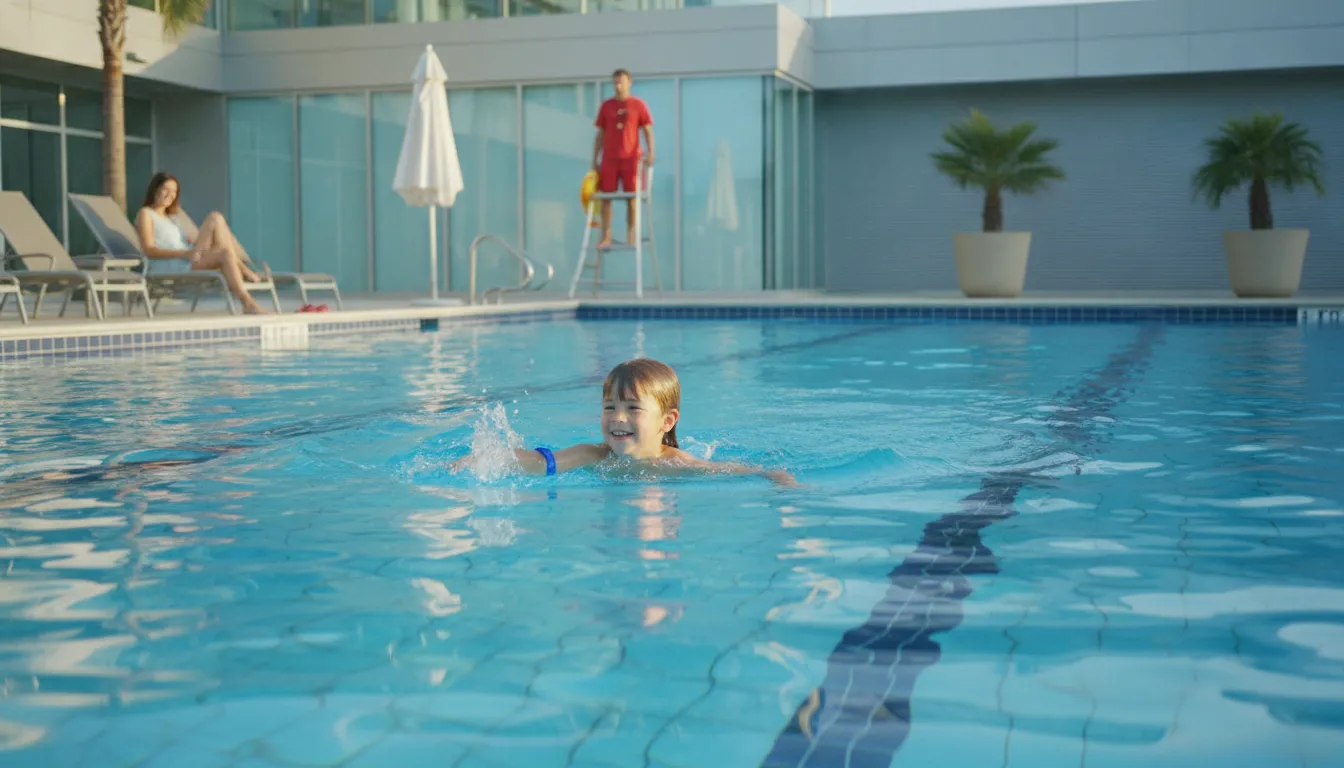
A child can be a confident swimmer and still need close, constant supervision at a public pool. The Centers for Disease Control and Prevention notes that drowning can happen in seconds and is often silent. While swimming lessons do not remove the need for attentive adults, even when a lifeguard is present. That makes the right safety conversation larger than choosing a watch that counts laps.
The best child swim tracker for public pools should support active supervision with reliable detection and rapid alerts to trained facility staff. Rather than promise that a wearable or app can keep a child safe by itself.
For parents, the practical question is what the technology can detect, who receives an alert, and how it fits into the pool's existing safety procedures. Understanding those differences helps you ask better questions and evaluate whether a facility-level system, such as WAVE's AquaSense swimmer wearables, could add another layer of protection. Start by separating ordinary activity tracking from technology designed for swimmer safety.
Get a free quote to help your public pool add WAVE AquaSense drowning detection
Choosing the Best Child Swim Tracker for Public Pools
In a public pool, the best child swim tracker is not simply a device that records laps, distance, or split times. It should support real-time safety by helping a supervised facility recognize when a swimmer may be in distress and alert the people responsible for responding.
That distinction matters because drowning does not look like an organized swimming activity. The CDC states that drowning can happen in seconds and is often silent. It also identifies drowning as the leading cause of death for children ages 1 to 4 and the second leading cause of unintentional injury death for children ages 5 to 14. A tracker that reports exercise data may be useful for training, but it does not necessarily identify a child who has stopped moving or needs immediate help.
Fitness tracking is different from drowning detection
Consumer fitness watches and swim apps are generally designed for the individual swimmer. They may count laps, estimate distance, track pace, or display workout summaries after a session. Those functions can help an older swimmer or coach measure performance, but they are not the same as monitoring a child's safety in a busy public pool.
A safety-focused system must be connected to the facility's response process. It should be able to identify an unusual or prolonged underwater event, communicate an alert to designated staff, and help those staff act quickly. Research on aquatic surveillance also supports the value of systems that use wearable sensors or other monitoring technology to enhance safety by providing early warning of distress. See this overview of a drowning prevention wearable for children for more context.
What facility-level monitoring adds
Facility-level drowning detection changes the question from "How many laps did my child swim?" to "Can the pool's safety team be alerted if a swimmer may need help?" The technology is managed by the pool. Not treated as a substitute for a parent's attention or a lifeguard's judgment. It creates another communication layer that can support trained staff during lessons, open swim, or other crowded conditions.
Swimming lessons do not remove the need for close and constant supervision, even when a lifeguard is present, according to the CDC. A child swim tracker should therefore be viewed as an additional layer of protection, not a guarantee of safety or a replacement for active supervision and lifeguards. For parents, the most useful question is whether their local pool has a system designed for facility response. Rather than whether a wearable can produce the most detailed workout report.
What Should a Child Swim Tracker Actually Do in a Public Pool?
A child swim tracker for a public pool should do more than record laps, estimate distance, or display exercise data. Its most important job is to recognize a potentially dangerous submersion and send a clear alert to the people responsible for responding. Because drowning can happen in seconds and is often silent, a useful safety system must support fast intervention rather than simply report activity after the fact. The CDC explains why rapid awareness matters.
A safety-focused swim tracker should detect prolonged submersion, communicate an alert within seconds, and fit into the facility's existing response process. It should add another layer of protection around children without creating the impression that technology replaces attentive adults or trained lifeguards.
Detect prolonged submersion, not just movement
Fitness watches and swim apps can be useful for tracking exercise, but those functions do not necessarily identify a child who is in distress. In a public pool. The relevant question is whether a wearable sensor can recognize an unusual or prolonged period beneath the water and distinguish that event from ordinary swimming activity. The system should be designed around drowning detection and early warning, not personal performance metrics.
Research on aquatic surveillance describes wearable-sensor and other detection systems as tools that can enhance safety by providing earlier awareness of distress around pools and waterways. That role is especially important when a child is not immediately visible to a parent or staff member. It does not remove the need for close supervision, swimming ability, or appropriate pool rules.
Alert the right people within seconds
Detection only helps when it leads to a response. A public-pool solution should route an understandable alert to lifeguards and, where appropriate, other designated staff who can reach the water quickly. WAVE's drowning-detection technology is designed to notify staff of a submerged swimmer so they can act within seconds. The exact response should be defined by the facility, including who receives the alert, where they go, and how the event is escalated.
This makes the technology a force multiplier for a trained aquatic team. It can provide an additional signal when visual attention is divided, but it cannot guarantee safety or replace lifeguards. Parents evaluating a facility can ask whether alerts reach the lifeguard team directly, whether staff practice the response, and how the system is monitored during operating hours. To see how the detection and alert process fits together, review how the WAVE safety system supports a public pool.
For families, the standard is straightforward: look for technology that is built to identify danger and shorten the path to human help. The best child swim tracker for public pools is not necessarily the device with the most fitness features. It is the safety layer that supports constant supervision and gives trained staff another timely way to recognize a swimmer may need immediate assistance.
How WAVE AquaSense Works as a Facility-Level Safety Layer
AquaSense swimmer wearables are designed to add a technology-based layer of protection across a public pool, rather than place the entire responsibility for detection on one person. Each non-tethered wristband works with the facility's WAVE equipment to help identify a submerged swimmer and send an alert to the people responsible for responding. That approach supports active supervision while giving lifeguards and staff another way to recognize a developing emergency.
The wristband's multi-year battery is a practical advantage for facilities and families. It does not require daily recharging, unlike competing wristbands that may need to be charged after each use. That means a pool can focus on fit, assignment. And operating procedures instead of treating every wearable like a device that must be charged before the next swim session. Learn more about AquaSense swimmer wearables and how they fit into a facility's safety plan.
Wireless coverage for real-world pool conditions
Public pools do not all have the same water clarity, layout, or construction options. WAVE's wireless drowning-detection approach does not require permanent construction, which can make deployment more flexible for existing facilities, seasonal operations, and pools that cannot undertake a major renovation. It is also designed to work in clear as well as murky or dark water, where a camera-based system may have limited visibility.
The system connects the wearable layer to the GUARDian Hub, allowing alerts to reach the appropriate responders. Depending on the facility's setup, that response may involve lifeguards, pool attendants, front-desk personnel, or security staff. WAVE describes its alerting capability as notifying staff so they can act within seconds. The goal is not to replace a lifeguard or suggest that technology can guarantee safety. It is to provide an additional signal when rapid recognition and response matter.
Why the facility matters more than the individual device
Parents searching for the best child swim tracker for public pools should ask what happens after a wearable detects a concern. A standalone watch or activity tracker may record movement, distance, or exercise, but a facility-level system is built around an alert path, designated responders, and an operating process. With WAVE, AquaSense swimmer wearables, lifeguard tags, and the GUARDian Hub work as parts of a broader aquatics-safety system.
Parents can ask their local pool whether it uses drowning-detection technology, how alerts reach staff, and who is trained to respond. Those questions help families evaluate the pool's safety infrastructure without treating any device as a substitute for close supervision. They also give aquatics directors a clear opportunity to explain how technology supports the lifeguard team.
What to Look For When Comparing Swim Trackers and Safety Systems
Parents comparing swim technology should first ask what the device is designed to detect. A consumer watch may record movement or laps, but that is different from a system intended to identify a swimmer in distress and alert trained staff. In a public pool, the strongest option is not a promise of perfect protection. It is a well-designed additional layer that works alongside supervision and an active lifeguard team.
Installation, alert routing, and day-to-day maintenance matter as much as the wearable itself. Use the comparison below as a starting point when discussing options with a pool director or aquatics manager.
| Criterion | Consumer fitness tracker or watch | Wearable drowning detection, such as WAVE AquaSense | Camera-based system |
|---|---|---|---|
| Safety purpose | Typically fitness, activity, or swim-data tracking for an individual user. | Drowning-detection technology designed to add another layer of swimmer protection in a supervised facility. | Visual surveillance intended to analyze activity within covered camera views. |
| Alert capability | May notify the wearer or a paired phone, but is not necessarily connected to pool staff or a drowning response process. | AquaSense works with WAVE equipment to alert lifeguards or designated staff to a submerged swimmer. See how WAVE lifeguard equipment fits into a facility safety plan. | Can generate alerts from camera analysis, depending on the system, coverage, configuration, and facility response plan. |
| Battery and recharge | Battery and charging requirements vary by product and use. | The AquaSense wearable has a multi-year battery and does not require daily recharging, according to WAVE. | Uses powered cameras and associated facility equipment rather than a child-worn battery. |
| Installation | Usually worn by the individual, with no pool-wide detection infrastructure. | Wireless deployment does not require the permanent construction associated with camera installations. | Often requires cameras, carefully planned coverage, networking, and permanent construction or mounting. |
| Murky or dark water | A watch may continue recording its own sensor data, but it does not provide visual coverage of the pool. | WAVE states that its wireless system works in clear, murky, and dark water. | Performance depends on visibility, lighting, camera placement, and the system's operating conditions. |
Also be cautious about treating floaties or arm bands as a tracking solution. The CDC notes that these products can slip off and do not prevent drowning, which means they can create false security rather than a dependable response layer. Any technology should complement close, constant supervision. WAVE is not a lifeguard replacement and does not guarantee that every incident will be detected or prevented.
Why Should Parents Ask Their Public Pool About Drowning Detection?
Parents can support safer public pools by asking how staff identify and respond to a swimmer in distress. The question is not an accusation, and it does not suggest that lifeguards are doing inadequate work. It opens a practical conversation about whether the facility has an additional way to notice a problem and alert the right people quickly.
Swimming lessons are valuable, but they do not make children water-safe without supervision. The CDC advises that children who have had swimming lessons still need close, constant supervision around water, even when a lifeguard is present. Drowning can happen in seconds and is often silent, which means a brief distraction or a moment outside a lifeguard's field of view can matter.
That is why parents should think beyond finding the best child swim tracker for public pools as a personal gadget. At a public pool, the more useful question is whether the facility uses a coordinated, staff-facing drowning-detection system that supports supervision. Technology should add another layer of protection, not replace lifeguards, parents, or the pool's safety procedures.
Parents are safety advocates, not just customers
A parent can ask an aquatics director whether the facility has a way to detect prolonged submersion, how alerts reach staff, and who responds when an alert occurs. Ask whether the system is designed for the pool's actual environment and whether employees receive training on the response process. These questions help families understand the facility's plan and give operators useful feedback about what matters to the people they serve.
Parents also have a role during every visit. Stay within close reach of young or inexperienced swimmers when appropriate, keep your attention on the water, and avoid distractions such as phone use or reading while supervising. A detection system can support a coordinated response, but it cannot remove the need for active adult supervision.
WAVE's resources can help families start this conversation. The parents page offers language for advocating for stronger aquatic safety, while this guide to a drowning prevention wearable for children explains how wearable sensors may provide an additional alerting layer. Asking informed questions helps parents choose facilities that take swimmer protection seriously and encourages public pools to evaluate practical tools that support their lifeguards.
Learn how WAVE AquaSense can become an extra layer of protection for your pool
How to Ask Your Local Pool About Child Swim Tracker Technology
Parents do not need to be aquatics technology experts to start a useful conversation with a local pool, YMCA, or camp. A clear question can help a facility explain how it monitors swimmers, responds to distress, and evaluates new safety tools. The goal is not to demand a particular product, but to advocate for an additional layer of protection alongside attentive supervision and trained staff.
Use the following steps as a practical conversation guide. You can adapt the wording to your facility, your child's age, and the type of swim program involved.
- Start with the front desk or program manager. Ask, "Who oversees swimmer safety technology or aquatics operations at this facility?" If the person at the front desk cannot answer. Request the aquatics director, pool manager, or another staff member responsible for safety decisions. A calm, specific conversation is more likely to reach the person who can evaluate an improvement.
- Ask whether the facility uses wearable drowning-detection technology. You might say. "Does the pool use any wearable system that can alert staff when a swimmer may be submerged or in distress?" This distinguishes a safety system from a standard fitness watch or swim-tracking app. Drowning can happen in seconds and is often silent, so ask how an alert reaches lifeguards, pool attendants, security, or other designated responders.
- Mention AquaSense as one example to investigate. If the facility is open to learning more, share the WAVE swimmer equipment page. Ask whether a facility-level system could fit the pool's programs, swimmer volume, and operating procedures. Keep the focus on evaluation rather than presenting any device as a substitute for lifeguards or responsible adult supervision.
- Offer useful resources, not pressure. Tell the manager that other parents may value another way to support swimmer protection, then offer to share WAVE's parent advocacy resources. Parents play an important role in encouraging facilities to consider drowning-detection technology. A concise resource can help staff bring the idea to an aquatics director, risk manager, board, or municipal decision-maker.
- Ask how equipment is maintained and used. Follow up with, "Who checks the equipment, trains staff, reviews alerts. And keeps the system ready for each program?" A responsible facility should be able to explain how technology fits its existing safety procedures. Ask how staff respond to alerts and how the facility communicates with families. While recognizing that drowning-detection technology is an additional layer of protection, not a guarantee of safety or a replacement for lifeguards.
These questions give families a constructive way to advocate for safer facilities while respecting the expertise of pool operators. If a facility wants technical or implementation information, direct its leadership to WAVE for a more detailed discussion.
Helping Your Pool Invest in Swimmer Protection Technology
Public pools often want stronger swimmer protection but must balance that goal against staffing, maintenance, and seasonal budget limits. A safety system should be practical to adopt, not an improvement that remains on a wish list because it requires a major capital purchase. WAVE's subscription-based model gives facilities a way to add drowning-detection technology through an accessible operating expense instead of funding the entire system upfront.
That approach can help aquatics directors present a clearer business case to boards, municipalities, and nonprofit leadership. The investment supports an additional layer of protection for swimmers while helping staff respond to alerts quickly. It does not replace lifeguards or remove the need for active supervision. Rather, WAVE is designed to work as a force multiplier for the team already responsible for pool safety.
Use grants and scholarships to close the funding gap
Facilities should also look beyond their annual operating budget. WAVE also provides affordable swimmer protection options and resources that outline potential ways to pursue financial assistance for drowning-prevention technology. The company works with ACCU, Aquatic Consulting & Underwater Services, and offers a scholarship program that can provide financial assistance to qualified nonprofit facilities that choose WAVE. That can be especially relevant for YMCAs, Boys & Girls Clubs, and municipalities serving families with limited access to safe swimming resources.
A facility can strengthen its request by connecting the technology to measurable operational needs. Consider documenting the number of swimmers served, the facility's hours and water environments, current alert procedures, and the staff who would receive notifications. A focused proposal can show that the goal is not simply to purchase another device. It is to improve the facility's response capability and provide families with greater confidence in the pool's safety practices.
Make monitoring part of daily pool operations
Affordability also depends on whether staff can use the system consistently. WAVE's Hub Management Software (HMS) helps public pools monitor swimmer activity and manage alerts as part of their normal operating workflow. With the right configuration, the technology can support lifeguards and facility personnel without creating a separate, disconnected process.
For organizations evaluating options, the GUARDian Hub aquatics safety technology can be considered alongside the facility's staffing plan, pool layout, and funding sources. Parents can help by asking their local pool whether it has a plan to add an extra layer of drowning detection. And by sharing WAVE's funding resources with decision-makers. A subscription model, grant research, and scholarship eligibility can turn that conversation into a realistic next step.
Explore WAVE drowning-detection options for your public pool today
Frequently Asked Questions
What is the best device for swim tracking?
The best option depends on the safety goal. A fitness watch tracks activity, while a drowning-detection wearable is designed to identify prolonged submersion and alert facility staff. For public pools, look for a system that supports lifeguards, works wirelessly, and adds protection without requiring permanent construction.
What's the best fitness tracker for kids?
A fitness tracker may be useful for recording movement or swimming activity, but it is not the same as a drowning-detection system. Parents should ask whether the device can alert trained pool staff during a possible emergency, rather than assuming activity data provides active supervision.
How can public pools detect drowning?
Public pools can combine attentive lifeguard supervision with drowning-detection technology. WAVE uses AquaSense swimmer wearables and facility alerting to notify staff when a swimmer may be submerged, helping them respond within seconds. It is an additional layer of protection, not a replacement for lifeguards.
Are wearable swim trackers safe for children?
Wearables can support safety when used as intended and alongside close, constant adult supervision. The CDC notes that drowning can happen in seconds and is often silent, so no device should create a false sense of security or replace responsible supervision: CDC water safety guidance.
Do I need a swim tracker for my child at the pool?
A swim tracker is not a substitute for supervision, swimming skills, or lifeguard oversight. Parents can ask their local pool whether it uses an additional drowning-detection layer, how alerts reach staff, and how the facility trains employees to respond. Those questions can help families advocate for stronger swimmer protection.
Ready to Help Your Public Pool Explore WAVE?
Parents can encourage local pools to consider an additional layer of swimmer protection that supports lifeguards and facility staff. To discuss how WAVE drowning-detection technology may fit your public pool, schedule a free consultation by calling 1-888-384-9283. The WAVE team can help your facility understand its options and determine a practical next step.
