
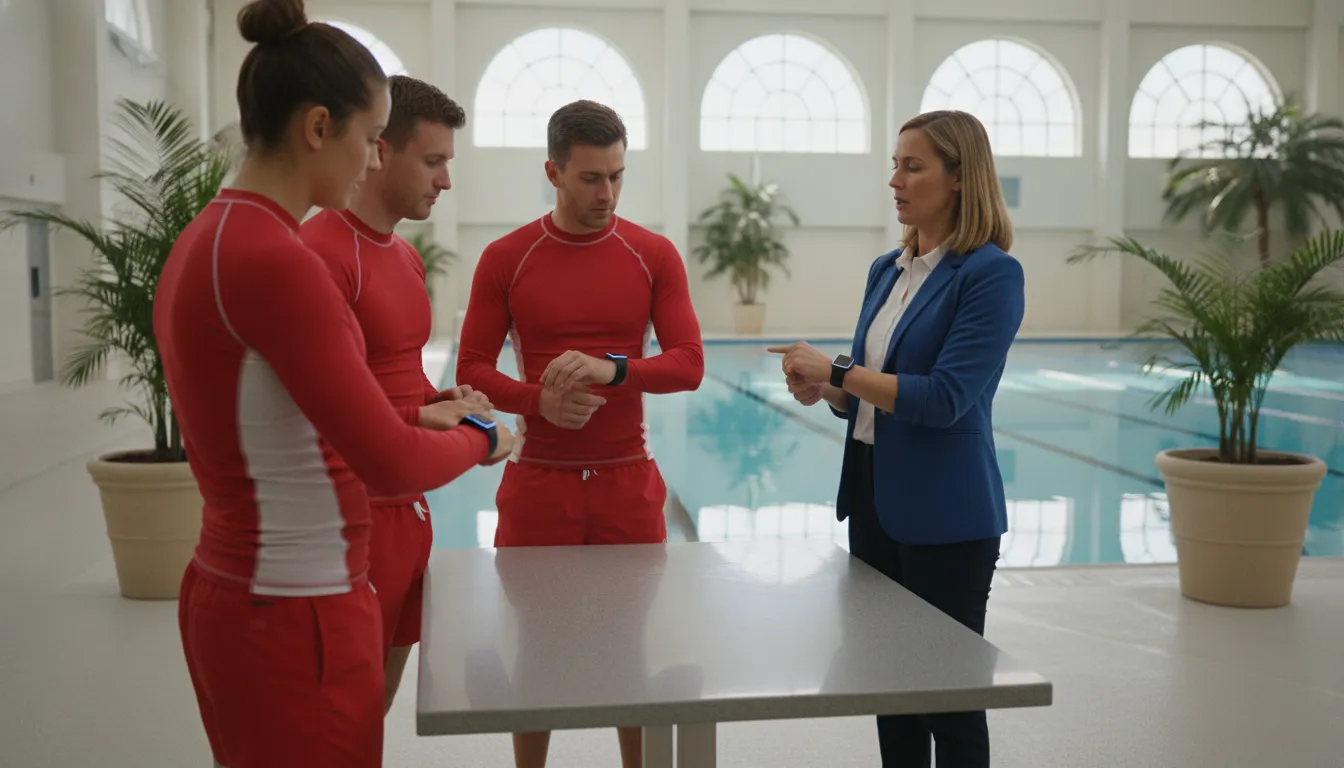
For a commercial pool operator, safety technology should strengthen active supervision, not create a false sense of security. The right system helps staff notice a possible prolonged submersion quickly, fits existing response procedures, and avoids adding unnecessary construction, downtime, or daily equipment charging.
The best commercial pool safety systems combine reliable alerts with practical deployment and clear staff protocols. WAVE's wireless approach uses AquaSense swimmer wearables and staff alerts as an additional layer of protection, supporting lifeguards rather than replacing them. An academic evaluation described the system as low-risk and easy to use for supplementing lifeguard monitoring of large groups (PubMed).
That distinction matters when comparing wearable detection, camera-based monitoring, and physical safeguards. Start by weighing how each option performs in your water conditions, how quickly your team can adopt it. And whether the system reinforces the people already responsible for watching swimmers.
Schedule a Free Consultation to evaluate the best commercial pool safety systems for your facility.
How to Choose the Best Commercial Pool Safety Systems for Your Facility
Aquatics directors rarely choose safety technology based on a single feature. The right system must fit daily operations, staff capabilities, facility infrastructure, and the realities of supervising swimmers in motion. It should also make an alert useful in the moment, without creating a second process that staff cannot consistently maintain.
Start by evaluating the system as an operational tool, not simply as a piece of equipment. A strong solution adds information to an established lifeguard response plan and helps staff focus attention where it is needed. It does not replace active supervision or promise that every incident can be prevented.
Look for real-time, actionable alerting
Ask what happens after a system detects a possible problem. Alerts should reach the people who can respond, in a format they will notice quickly, such as a vibrating staff device, an audible facility alarm, or both. The academic evaluation of WAVE describes a system in which swimmer-worn sensors can alert vibrating staff bracelets and audible alarms after prolonged submersion. Staff also reported that alerts helped bring attention to risky underwater play and swimmers leaving the pool area. Read the published evaluation of WAVE.
During a demonstration, ask to see the complete alert path: detection, notification, staff acknowledgment, and response. Clarify how the system handles false alerts, signal range, battery management, and alert history. A notification that cannot be heard, felt, or understood quickly is less valuable than a simpler system that staff can act on immediately.
Measure training and daily usability
Training requirements affect adoption, especially at seasonal facilities, camps, and pools with rotating staff. The evaluation found WAVE easy to learn and use, while staff considered the awareness of risky behavior useful. Those findings do not eliminate the need for facility-specific training, but they provide a practical benchmark: staff should be able to understand the alert. Identify the swimmer or zone involved, and follow the response protocol without excessive technical instruction.
Review how swimmers receive and return wearables, how staff test devices before a shift, and who owns charging or battery checks. The GUARDian Hub (w3000) can be assessed as part of that broader workflow, rather than in isolation from the people who will operate it.
Account for infrastructure and total cost of ownership
Construction requirements can change a project from a quick operational improvement into a major capital initiative. Ask whether the system needs permanent cameras, pool modifications, new network infrastructure, permits, or extended closures. Wireless wearable approaches can reduce that burden and provide flexibility for facilities that change layouts or operate seasonally. Also compare recurring subscriptions, replacement hardware, batteries, software, training, maintenance, and staff time instead of comparing purchase prices alone.
Confirm that the system supports lifeguards
Finally, assess whether the technology strengthens the facility's existing safety model. WAVE has been evaluated as low-risk, easy to use, and capable of supplementing lifeguard monitoring. WAVE describes its role as a force multiplier rather than a replacement for human lifeguards. The best commercial pool safety systems should make vigilance more informed and response more coordinated, while keeping trained staff responsible for supervision and intervention. Learn how WAVE positions technology as a lifeguard force multiplier.
Wearable Technology vs. Camera-Based Systems: What Operators Should Know
Choosing among the best commercial pool safety systems starts with the facility itself. Pool layout, water visibility, construction constraints, staffing model, and response procedures all affect whether a technology can add practical value. Wearable and camera-based systems can both contribute to a broader aquatic safety strategy, but they detect risk in different ways and create different operational requirements.
Wearable systems place detection technology with the swimmer, while camera-based platforms use fixed equipment and software to observe activity from outside the water. For operators considering a new installation, that distinction can influence project timing, maintenance, and how alerts reach staff. WAVE's approach is wireless and designed to work in clear, dark, or murky water without permanent construction, while camera systems may require more extensive site preparation.
| Consideration | Wearable drowning-detection system | Camera-based system |
|---|---|---|
| Permanent construction required | Wireless deployment without permanent pool construction. | Some commercial platforms, including Poseidon, Lynxight, and AngelEye, require permanent construction. |
| Water conditions | Can operate in clear, dark, or murky water because detection is not dependent on an unobstructed camera view. | Performance depends on camera placement, visibility, and the system's ability to interpret the observed water environment. |
| Deployment time | Typically avoids construction scheduling and can support a faster operational rollout. | May involve site assessment, installation, calibration, and construction coordination. |
| Upfront cost | Often suited to an affordable hardware-as-a-service or subscription model. | Can include cameras, installation, infrastructure, and project labor, depending on the facility. |
| Ongoing cost | Includes wearable and alert-system service, equipment care, and staff procedures. | Includes software, monitoring, maintenance, and possible hardware or infrastructure support. |
| Alert mechanism | Prolonged submersion can trigger vibrating staff bracelets and audible alarms. | Computer-vision alerts are generated from activity detected by fixed cameras. |
| Staff training | Training focuses on wearing equipment correctly, recognizing alerts, and following response protocols. | Training may include interpreting camera alerts, managing coverage, and responding to system notifications. |
These differences do not make one category universally right for every pool. Camera-based monitoring may suit facilities prepared for permanent infrastructure and fixed visual coverage. Wearables can be a practical fit for operators who need flexibility, faster deployment, or coverage that is less dependent on water clarity. Academic evaluation described WAVE as low-risk and easy to use, with alerts helping staff notice prolonged submersion and risky underwater behavior. The system is intended to supplement lifeguard monitoring, not replace it.
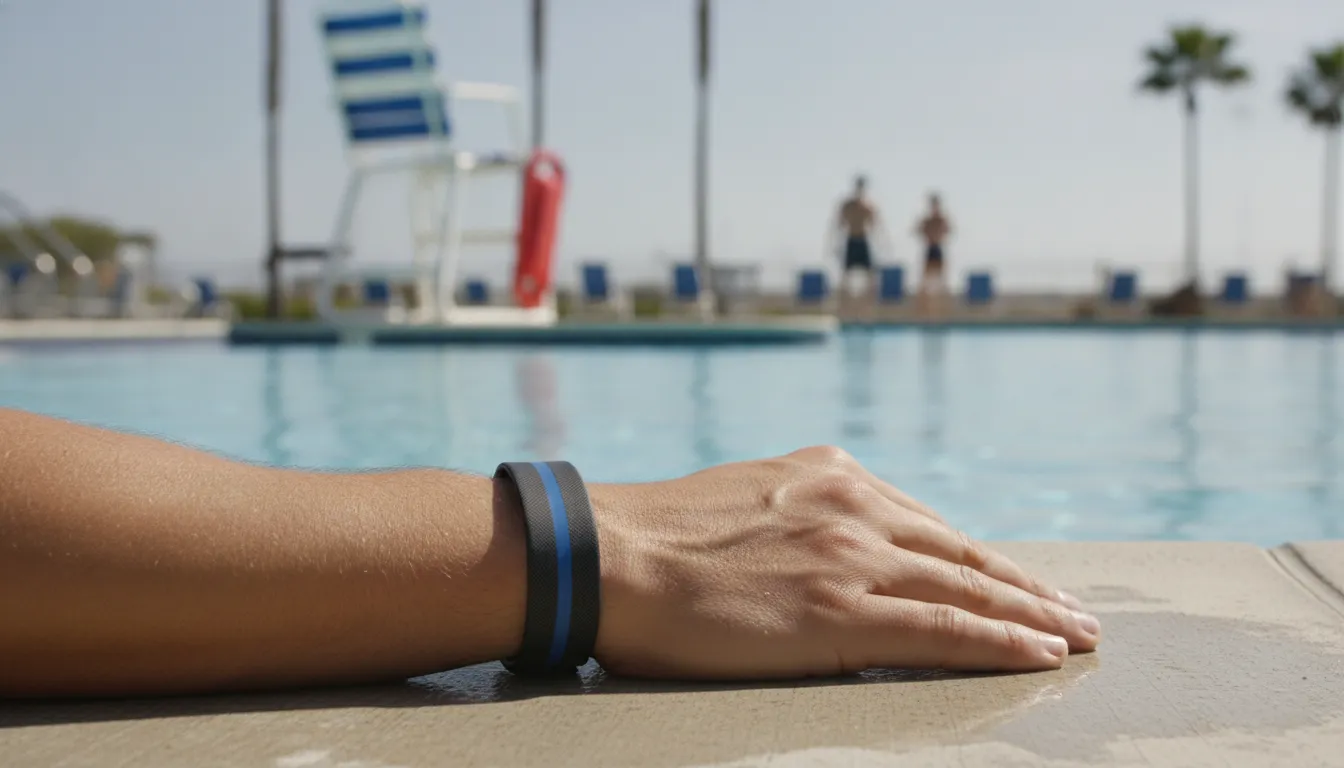
Operators can review the full product lineup and examine the AquaSense swimmer wearables before comparing deployment requirements with their existing emergency action plan. The strongest choice is the one staff can use consistently, connect to a clear response process, and maintain over time.
How Does Drowning Detection Technology Support Your Lifeguards?
A commercial pool can place significant demands on a small lifeguard team, especially when staff are supervising camps, lessons, open swim, or other large groups of children. In these settings, a high child-to-staff ratio can make continuous observation more difficult and increase drowning risk. The right technology adds another channel of awareness without weakening the human judgment, scanning, and response that lifeguards provide.
Drowning detection technology works as a force multiplier for lifeguards. By alerting staff to prolonged submersion or other defined events, it can help a small team recognize developing problems sooner while lifeguards remain responsible for supervision and intervention.
That distinction matters when operators evaluate the best commercial pool safety systems. A detection system is not an autonomous substitute for trained staff, and it cannot guarantee that every incident will be identified or prevented. It is an additional layer of protection within a supervised aquatic environment, designed to help lifeguards direct attention where it may be needed most. WAVE's positioning is explicitly collaborative: the technology is intended to partner with lifeguards, never replace them. Lifeguard alert tools are most valuable when they reinforce a facility's existing surveillance and emergency-response procedures.
Turning a developing problem into an actionable alert
Wearable detection systems give staff a signal when a swimmer remains submerged for a prolonged period. In the academic evaluation of the WAVE Drowning Detection System, the system was described as using swimmer-worn headbands to send alerts to vibrating staff bracelets and audible alarms. WAVE's current product terminology uses AquaSense swimmer wearables, but the operational principle is the same: a possible problem generates an alert that staff can investigate promptly.
Vibration is useful because it can reach a lifeguard who is actively scanning the water, while an audible alarm can increase awareness among nearby staff. The alert does not make the final decision. A lifeguard still assesses the swimmer, confirms what is happening, and follows the facility's rescue and emergency protocols. This keeps technology in its proper role while reducing the chance that a concerning event goes unnoticed during a busy period.
Helping teams cover busy, complex pool environments
The research was conducted in a setting where a small number of lifeguards and staff monitored groups of children. The study found that the system was low-risk and easy to use, and concluded that it may supplement lifeguard monitoring of large groups. Staff also reported that awareness of risky underwater play was useful. These findings support a practical use case for camps, community pools, and other facilities where attention must be distributed across many swimmers.
For operators, the goal is not simply to add another device. The goal is to create a clear response path: staff know what an alert means. Who investigates it, how coverage is maintained during a rescue, and how the event is documented. Training should include normal alert behavior, false-alert handling, equipment checks, and integration with existing lifeguard rotations. For a broader comparison of approaches and selection criteria, read our guide to drowning detection systems.
A well-designed system strengthens vigilance rather than encouraging complacency. Lifeguards continue active surveillance, enforce pool rules, communicate with one another, and respond to emergencies. Detection technology provides an added prompt when prolonged submersion or another configured event warrants attention. Used with qualified staff and established procedures, that combination can make supervision more resilient when a facility is crowded or operating with a lean team.
What Commercial Pool Safety Technology Really Costs
For facility operators, the purchase price is only one part of a pool safety technology decision. The larger question is how the system affects construction planning, staff workflows, operating budgets, and the facility's ability to remain open during deployment. A useful comparison should consider total cost of ownership, not just the equipment line item.
Camera-based systems can involve permanent installation work, including site assessment, construction coordination, permitting requirements, and possible downtime while equipment is installed. Those project costs may be appropriate for some facilities. But they can make adoption harder when a pool has a tight capital budget, seasonal operations, or multiple aquatic areas to protect. They also need to be evaluated against the conditions in which cameras can reliably observe swimmers, including water clarity, lighting, and pool configuration.
WAVE uses a subscription and Hardware-as-a-Service approach designed to reduce the need for a large upfront capital purchase. WAVE's published pricing page frames its plans as starting at less than $5 per day (or less than $10 per day for a broader bundle). With 12-month or 36-month term options and a $0 deductible replacement warranty. Current monthly pricing listed on the WAVE site is:
- GUARDian Lifeguard Alert Bundle: $199 per month (12-month term), $169 per month (36-month term), or $149 per month (36-month AdvancePay).
- GUARDian Swimmer Protection: $399 per month (12-month term), $339 per month (36-month term), or $299 per month (36-month AdvancePay).
Actual system configuration depends on the facility, number of monitors, swimmer volume, term commitment, and operating model. However, subscription pricing gives operators a more predictable way to budget for an additional layer of protection. It can also make it easier to scale coverage or plan upgrades without treating every technology decision as a major construction project. Review WAVE's transparent subscription pricing and confirm the current configuration and quote for your site before making a purchasing decision.
Cost should also be measured against operational value. WAVE is intended to support lifeguards with alerts and monitoring assistance, not replace trained staff or active supervision. The GUARDian system can help facilities add another response layer while preserving established lifeguard protocols. An academic evaluation described WAVE as low-risk, easy-to-use technology that may supplement lifeguard monitoring of large groups of children in pools: the published study is available through PubMed.
For risk managers, the financial case extends beyond installation. Advanced aquatic safety systems can support lifeguard efficiency, strengthen a facility's safety reputation. And help reduce institutional liability when they are implemented as part of a broader safety program. WAVE's own guidance positions drowning detection as a force multiplier for lifeguards, alongside appropriate training, supervision, and facility procedures. The best commercial pool safety systems are therefore not necessarily the ones with the highest initial price. They are the systems that deliver actionable support, fit the facility's physical environment, and remain financially sustainable over time.
How Do You Deploy a Modern Safety System at Your Facility?
Adding safety technology should strengthen daily operations, not create a new disruption for staff or swimmers. The strongest deployment plan starts with the facility's actual risks, coverage needs, and emergency procedures. It also gives the team time to understand how alerts fit into lifeguard vigilance. Because technology is an additional layer of protection rather than a replacement for trained personnel.
There is no single solution for every commercial aquatic environment. Effective strategies can include wearable drowning detection technology, camera-based AI monitoring, and traditional physical barriers, depending on the layout, water conditions, staffing model, and operating goals. A practical rollout can follow these steps:
- Conduct a risk and facility assessment. Map the pool deck, blind spots, water depths, activity areas, entrances, and locations where staff must respond quickly. Review swimmer volume, age groups, peak operating periods, staffing ratios, and existing emergency procedures. Include input from aquatics directors, lifeguards, maintenance staff, and risk managers so the selected system addresses operational reality instead of an idealized floor plan.
- Choose the system type that matches your coverage. Compare wearable, camera-based, and barrier-based approaches against the risks identified in the assessment. Camera systems may suit facilities that can support permanent construction and fixed viewing zones. Wearables may be a better fit when operators need wireless coverage that works in clear, dark, or murky water. For a wearable deployment, review the GUARDian Hub (w3000) and related equipment to confirm that the alert path, swimmer coverage, and staff notifications match the facility's needs.
- Plan installation around operating hours. Ask what construction, wiring, closures, and maintenance access each option requires. A system that forces a lengthy pool shutdown can create financial and scheduling pressure, even if its features are attractive. WAVE's wireless approach is designed for deployment in hours without permanent construction, helping facilities keep pools open while the system is introduced. Confirm the installation sequence, test locations, charging or battery expectations, and staff access before the rollout begins.
- Train lifeguards and support teams. Training should cover normal system operation, alert meanings, wearable assignment, equipment checks, false-alert review, and escalation responsibilities. An academic evaluation described the WAVE system as low-risk and easy to use, and staff found it easy to learn and operate. Use hands-on drills so lifeguards, supervisors, front-desk personnel, and other designated responders know what they should do when an alert occurs.
- Integrate alerts with emergency response protocols. Document who receives each alert, who scans the water, who contacts additional help, and who records the event. Run controlled scenarios during a low-traffic period, then adjust alert handoffs and communication points. The system should make an existing response plan faster and more coordinated, while lifeguards retain responsibility for active observation and in-water decisions.
- Review incident logs and refine the program. After launch, review alerts, response times, equipment issues, and recurring behaviors with the team. Risky underwater play or leaving the pool area may generate useful alerts, even when no emergency occurs. Use that information to improve swimmer orientation, staff positioning, training, and operating procedures. Reassess coverage whenever the facility changes its layout, programming, or staffing model.
The best commercial pool safety systems are the ones staff can use consistently without forcing the facility to choose between better protection and keeping the pool open. A measured rollout makes the technology part of the safety culture from the first day.
Questions to Ask Before You Invest in Pool Safety Technology
Choosing a commercial pool safety system is not simply a matter of selecting the most advanced feature set. Operators need technology that fits the facility's water conditions, staffing model, budget, and existing emergency procedures. The best commercial pool safety systems add useful information at the moment staff need it, without creating a complicated process that teams cannot consistently operate.
Use these questions to compare options objectively. A strong answer should explain how the technology works in your facility, what staff will do when an alert occurs, and what the system requires after installation.
- What type of system matches our risk profile? Effective aquatic safety strategies can include wearable drowning detection, camera-based monitoring, and physical barriers, depending on the environment and use case. Camera systems can provide broad visual oversight, while wearable systems focus alerts on tagged swimmers and can identify prolonged submersion. Consider whether your priority is facility-wide observation, localized response, or an additional layer alongside active supervision. Review the full product lineup to compare components designed for different facility needs.
- How does the system detect a potentially dangerous event? Ask what the sensors or cameras measure, how long a swimmer must remain submerged before an alert, and where that alert appears. In a wearable model, swimmer devices can detect prolonged submersion and notify staff through vibrating bracelets and audible or facility alerts. The value is not just detection. Alerts must be noticeable, understandable, and actionable during normal pool noise and activity. Ask for a demonstration using the staff workflow your team would follow.
- Will the technology require construction or create facility downtime? Installation requirements can materially change the cost and operational disruption of a project. Camera-based systems may require permanent infrastructure and carefully positioned hardware. A wireless wearable approach can be deployed without that type of construction, which may be more practical for leased facilities, seasonal pools, or operators managing multiple sites. Confirm what equipment must be mounted, wired, calibrated, or taken offline for maintenance.
- Is this equipment mandatory, and what does compliance actually require? Requirements vary by jurisdiction, facility type, and sometimes insurance policy. Do not assume that purchasing a detection system satisfies every applicable code or replaces required supervision, staffing, signage, training, or inspection practices. Ask your local authority, counsel, and insurance carrier which standards apply. Treat technology as a risk-management tool and additional protection, not as a legal shortcut or a guarantee of swimmer safety.
- What is the total cost beyond the initial purchase? Request a complete view of subscription or equipment fees, wearable replacement, batteries, software, training, support, and expansion. Compare the cost of ownership with the infrastructure and maintenance demands of competing approaches. A subscription or hardware-as-a-service model may make wireless deployment more accessible, but the right choice depends on swimmer volume, pool layout, and alert coverage. Ask for pricing based on your actual operating model rather than a generic package.
- Can the system strengthen our lifeguard protocols? The answer should be yes, provided the system is designed as a force multiplier rather than a lifeguard replacement. Staff still supervise, assess alerts, respond, and document incidents according to facility policy. Technology can add another signal when a swimmer is submerged or a lifeguard enters the water, helping teams coordinate a faster response. Ask the vendor to map alerts into your current rotations, emergency action plan, drills, and escalation chain before you commit.
These questions shift the buying decision from feature lists to operational fit. The strongest system is one your staff can learn, trust, and use consistently while maintaining vigilant human supervision.
Ready to add pool safety technology your lifeguards can count on? Schedule a Free Consultation.
Frequently Asked Questions
What are the most effective commercial pool safety systems?
The strongest approach combines active lifeguard supervision with technology matched to the facility. Wearable drowning detection systems can alert staff to prolonged submersion, while camera-based monitoring and physical barriers may address different site needs. The right choice depends on water conditions, pool layout, staffing, deployment requirements, and how quickly staff can act on an alert.
How do drowning detection systems work for commercial pools?
Wearable systems use swimmer devices to detect prolonged submersion and send an alert to staff, such as through vibrating bracelets or audible facility alarms. WAVE's AquaSense wearables are designed as an additional layer of protection, helping lifeguards notice a potential emergency without replacing visual supervision or established rescue protocols. See the academic evaluation at PubMed.
Are commercial pool safety systems mandatory?
Requirements vary by jurisdiction, facility type, applicable health codes, and insurance conditions. Operators should confirm requirements with their local authority having jurisdiction, risk manager, and insurance carrier. Whether or not a system is legally required, it should be evaluated as part of the facility's broader supervision, emergency response, training, and risk-management plan.
What is the difference between wearable safety systems and camera systems?
Wearable systems provide swimmer-level detection and can be deployed without permanent construction. Camera systems monitor a broader visual area but may depend on fixed infrastructure and suitable visibility. WAVE's wireless approach is designed to work in clear, dark, or murky water, making water conditions and installation constraints important factors in the comparison.
Can commercial pool safety systems integrate with existing lifeguard protocols?
Yes, when alerts are incorporated into the facility's existing scanning, communication, rescue, and incident-response procedures. Staff should know what each alert means, who responds, and how the event is documented. WAVE is positioned as a force multiplier that supports lifeguards and adds another layer of swimmer protection in supervised aquatic environments.
Schedule a Free Consultation for Your Facility
Choosing a commercial pool safety system is easier when the technology, alert process, and staff responsibilities fit your facility. WAVE can help you evaluate an approach that adds another layer of protection while supporting your existing lifeguard protocols. Schedule a Free Consultation to discuss your goals and identify a practical next step.
