
Shallow Water Blackout: What Aquatic Safety Professionals Need to Know
A swimmer does not need to be far from the surface for a serious hypoxic event to occur. Shallow water blackout is a loss of consciousness underwater caused by oxygen deprivation, often after prolonged breath-holding or voluntary hyperventilation. Because the event can be silent, it may not look like an emergency during routine visual scanning.
Shallow water blackout is an underwater loss of consciousness caused by critically low oxygen, often after breath-holding practices that delay the normal urge to breathe. It can happen in water less than 15 feet deep, according to the National Center for Biotechnology Information, so depth alone is not a reliable measure of risk.
For aquatic safety professionals, the practical response begins with understanding what changes inside the swimmer's body, then translating that knowledge into clear rules, staff education, and layered monitoring. The physiology explains why breath-holding drills and underwater challenges deserve particular attention.
What is a shallow water blackout?
A shallow water blackout is a hypoxic underwater blackout. In practical terms, a swimmer loses consciousness because the brain is not receiving enough oxygen while the person is still underwater. The event can happen without a struggle, shout, or obvious sign of distress, which makes it an important risk for every supervised aquatic facility to understand.
The word shallow describes the setting, not the severity. According to the National Center for Biotechnology Information, this type of blackout often occurs in water less than 15 feet, or 5 meters, deep, although it can also affect swimmers or divers at greater depths. A swimmer does not need to be in deep water for a loss of consciousness to become a life-threatening submersion event.
The term hypoxic refers to inadequate oxygen. A person may hold their breath underwater after voluntarily hyperventilating. Hyperventilation can reduce carbon dioxide in the bloodstream and delay the normal urge to breathe, even as oxygen continues to fall. The swimmer may therefore remain underwater longer than is safe without recognizing the danger. The American Red Cross explanation of shallow water hypoxic blackout distinguishes this oxygen-deprivation event from the ordinary discomfort that signals a person to take a breath.
That distinction matters operationally. A swimmer experiencing a blackout may become motionless and sink rather than visibly panic. The event can be silent and difficult to identify through visual scanning alone, as the NCBI reference notes. This does not diminish the value of trained lifeguards. It reinforces why facilities should combine clear rules, active supervision, staff training, and appropriate swimmer monitoring technology.
For aquatics directors and operators, the key takeaway is not to judge risk by water depth or by whether a swimmer appears calm. Prolonged underwater breath-holding deserves a clear safety response, and any suspected loss of consciousness should be treated as an emergency under the facility's established procedures. Technology can support that response as an additional layer, while lifeguards remain responsible for supervision, assessment, and intervention.
Shallow water blackout is a silent loss of consciousness caused by oxygen deprivation during underwater breath-holding. It can occur in relatively shallow water, so depth and a swimmer's calm appearance should never be treated as proof that the situation is safe.
Why can breath-holding drills trigger a shallow water blackout?
Breath-holding drills can create a dangerous mismatch between how a swimmer feels and what is happening physiologically. Voluntary hyperventilation lowers carbon dioxide in the blood. Because rising carbon dioxide normally creates the urge to breathe, starting a breath hold after hyperventilating can delay that warning signal while oxygen continues to decline. A swimmer may therefore feel able to continue even as the brain is approaching oxygen deprivation.
That delay is central to a shallow water blackout. The swimmer does not necessarily experience a dramatic struggle or an obvious request for help. Consciousness can be lost underwater before the person reaches the surface. The event may be silent, which makes it especially difficult to identify through visual scanning alone. For a facility team, this is a reason to address the activity itself, not simply to rely on a swimmer's ability to recognize distress.
Why ascent can increase the danger
Pressure also matters when a swimmer changes depth. At greater depth, the surrounding pressure affects the partial pressure of the gases being breathed or held in the lungs. During ascent, that pressure falls. The oxygen partial pressure can fall quickly enough that a swimmer who appeared capable at depth loses consciousness close to the surface or during the final portion of the ascent. This is why the term "shallow" should not be interpreted as low risk. The event can occur in relatively shallow water, but depth and movement do not make prolonged breath holding predictable or safe.
The risk increases when drills are prolonged, repeated, competitive, or framed as tests of endurance. Competitions and underwater challenges encourage participants to ignore the urge to breathe and extend the time underwater. Fatigue, peer pressure, distraction, and a desire to outperform others can further reduce good judgment. WAVE's topic guidance identifies dangerous prolonged breath-holding drills, sometimes misidentified as training, as a significant aquatic risk. The American Red Cross advises discouraging underwater swimming competitions and breath-holding challenges in its guidance on shallow water hypoxic blackout.
Facilities should not respond by prescribing a breath-hold routine or treating repeated underwater endurance as a normal skill test. A safer approach is to prohibit prolonged breath-holding activities, explain the physiology to staff and guests, and maintain supervision and response readiness. Education is an important first line of defense, while swimmer monitoring technology can provide an additional layer of awareness for supervised aquatic operations. Technology supports trained lifeguards and does not replace them.
Hyperventilation can suppress the urge to breathe while oxygen falls, making a blackout possible before a swimmer recognizes danger. Changes in pressure during ascent and competitive or prolonged drills can make breath-holding especially hazardous.
How should facilities address shallow water blackout risk?
A clear protocol turns a difficult-to-see hazard into a manageable operational responsibility. The goal is not to eliminate normal swimming or underwater play, but to prevent prolonged breath-holding challenges from being treated as harmless training. Facilities should align their rules with established CDC drowning-prevention guidance, then make those rules visible, teachable, and easy for staff to enforce.
- Write the policy. Prohibit prolonged breath-holding, underwater swimming competitions, and breath-holding games. Define what staff should do when they see the behavior, including a calm instruction to stop and an escalation path for repeated noncompliance. WAVE guidance also recommends facility protocols that identify and prohibit these activities rather than leaving decisions to individual guards.
- Use specific signage. Place plain-language notices at entrances, deck areas, changing rooms, and program check-in points. State that breath-holding challenges and underwater contests are not permitted. Avoid vague language such as "swim safely," which does not tell guests what behavior creates risk. Include the rule in program materials and membership communications.
- Train every aquatic employee. Lifeguards, instructors, coaches, supervisors, and front-desk staff should understand why a swimmer may lose consciousness without a dramatic struggle. Training should cover the policy, recognition of prohibited activities, communication with guests, emergency activation, and documentation. Practice the response so enforcement is consistent across every shift.
- Make observation active. Maintain assigned scanning zones, rotate guards according to the facility's operating procedures, and keep attention on submerged swimmers as well as surface behavior. Supervisors should watch for informal contests, repeated underwater laps, or groups encouraging extended breath-holding. Staff vigilance remains central, even when a facility uses additional monitoring.
- Educate guests before risk occurs. Explain the rule during lessons, camps, team practices, orientations, and private rentals. Parents and program leaders should know that encouraging children to hold their breath longer is not a safe skill-building exercise. Education is a first line of defense, and a respectful explanation usually gains more cooperation than a warning delivered only after a problem develops.
- Prepare for a rapid response. Keep rescue equipment accessible, confirm that staff know how to activate emergency communications, and rehearse the handoff between lifeguards, managers, and emergency medical services. Review incidents and near misses during regular safety audits, including whether signage, staffing, training, and communication worked as intended. For a broader look at drowning-detection systems, evaluate technology as an added layer within this protocol, never as a reason to reduce trained lifeguard coverage.
Facilities can reduce shallow water blackout risk by prohibiting prolonged breath-holding, educating guests, training staff, maintaining active observation, and rehearsing emergency response. Layered technology may support those practices, but it does not replace lifeguard judgment or supervision.
Why visual scanning alone may not be enough
Visual scanning remains a foundational lifeguard skill. Trained guards continuously scan their zones, recognize changes in swimmer behavior, and respond when something appears wrong. The challenge is that a shallow water blackout may not create the obvious movement, struggle, or noise that draws attention. The event can be silent, so a swimmer may lose consciousness before a guard has a visible signal to investigate.
The National Center for Biotechnology Information notes that shallow water blackout can be difficult to identify through visual scanning alone because the loss of consciousness is caused by oxygen deprivation underwater. A swimmer may look still rather than distressed, particularly in a busy pool where normal pauses, underwater play, and overlapping bodies create visual complexity. This is not a criticism of lifeguards. It is a reminder that even disciplined observation operates within human limits.
Visual scanning is essential, but a silent submersion can be hard to recognize in time. Layered monitoring gives trained staff another way to become aware of a potential problem and begin the appropriate response.
Facilities can address this gap by combining strong supervision with clear rules, staff training, and technology that supports awareness. Policies should prohibit prolonged breath-holding activities and underwater competitions, while staff should know how a hypoxic event can differ from ordinary swimmer behavior. Regular review also helps leaders identify blind spots in pool layout, staffing coverage, and response procedures.
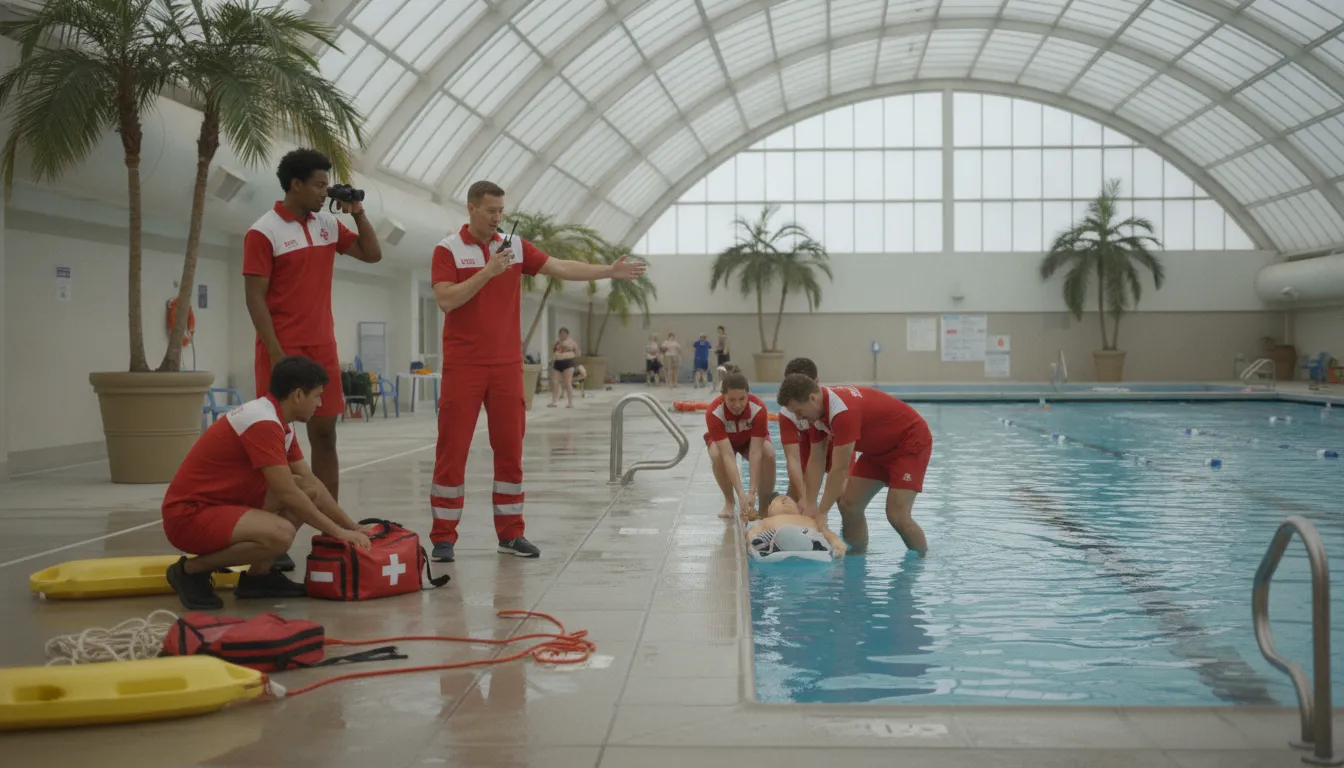
Technology is most useful when it complements, rather than distracts from, the guard team. WAVE is designed as a force multiplier for supervised aquatic environments. Its wearable sensors and hub can alert staff to prolonged submersion, creating an additional awareness signal when a visual cue may be subtle or absent. The system is intended to strengthen existing monitoring routines, not reduce lifeguard staffing or transfer responsibility away from trained professionals.
For operators evaluating options, the swimmer monitoring technology guide explains how proactive detection can fit into a broader safety plan. The GUARDian system provides more detail on how WAVE connects facility alerts with lifeguard support. Together, observation, prevention policies, and responsive technology give staff more information to act on when a swimmer's condition is not immediately apparent.
How does WAVE add another layer of swimmer protection?
A shallow water blackout can be silent, which means a trained lifeguard may have limited visual cues to identify trouble before a swimmer becomes unresponsive. That is not a criticism of guard performance. It is a reason for facilities to combine sound policies, active supervision, staff training, and technology that can provide another signal when prolonged submersion occurs.
WAVE is designed as a force multiplier for supervised aquatic environments. AquaSense swimmer wearables provide the sensing layer, while lifeguard tags support staff awareness and response. The GUARDian Hub (w3000) manages connectivity and alerts, helping route information to the people responsible for responding. This layered approach supports lifeguards rather than reducing the need for them.
| Facility need | Staff role | WAVE layer |
|---|---|---|
| Prevent unsafe breath-holding activities and maintain active supervision. | Set expectations, scan continuously, educate swimmers, and follow response protocols. | AquaSense swimmer wearables and lifeguard tags add technology-supported awareness around potential prolonged submersion. |
| Recognize a problem in varied operating conditions, including water where visibility is not ideal. | Interpret the alert, locate the swimmer, and carry out the facility's trained response. | WAVE is designed to operate in clear and murky water, adding a detection signal that does not depend only on camera visibility. |
| Coordinate information across the facility without major permanent construction. | Keep equipment ready, acknowledge alerts, document incidents, and review procedures. | The GUARDian Hub (w3000) manages alert connectivity for the system's wearable and staff components. |
For facility leaders, the practical value is not a promise that every incident will be prevented. WAVE does not replace lifeguards, eliminate the need for policies, or remove the responsibility to supervise swimmers. It gives staff an additional source of information that can complement visual scanning and established emergency procedures. Review the available lifeguard alert equipment alongside your staffing model, pool layout, and response plan.
Facilities evaluating options can also compare broader swimmer monitoring technology and different drowning-detection systems. The right choice should fit the environment and strengthen the human safety system already in place, especially when a risk such as shallow water blackout may not announce itself clearly.
WAVE adds a technology-supported alert layer through AquaSense swimmer wearables, lifeguard tags, and the GUARDian Hub (w3000). It helps trained staff respond to potential prolonged submersion in clear or murky water, but it does not replace supervision or lifeguards.
What should a facility include in its safety plan?
A strong aquatic safety plan turns general concern into specific responsibilities. It should explain how the facility prevents foreseeable hazards, supervises swimmers, responds to alerts, and learns from near misses. For shallow water blackout risk, leadership should address both behavior and operations rather than relying on a single safeguard.
Set clear policies and communicate them
Write a policy that identifies and prohibits prolonged breath-holding, underwater contests, and breath-holding games. The American Red Cross advises discouraging underwater swimming competitions and breath-holding challenges, so the rule should apply consistently to lessons, camps, rentals, practices, and open swim periods. Post plain-language signage at entry points, on the pool deck, and in briefing materials. Staff should also explain the reason for the rule to swimmers, parents, coaches, and rental groups.
Define staffing, training, and response roles
Document lifeguard zones, rotations, break coverage, supervisor responsibilities, and escalation procedures. Training should cover the signs of distress, the possibility of a quiet submersion, emergency action plans, first aid, and how staff respond when a monitoring alert is received. Technology can support trained lifeguards, but it should never be used to justify reducing required coverage or replacing active supervision. The CDC's drowning-prevention guidance is a useful reference when reviewing facility practices: CDC drowning-prevention resources.
Use layered monitoring and review the plan
Evaluate whether the facility needs additional swimmer monitoring technology alongside scanning, signage, and staff vigilance. WAVE describes its system as a force multiplier for lifeguards, adding another layer of protection in supervised aquatic environments. Its wearable sensors and hub are designed to alert staff to prolonged submersion, including in clear or murky water. Review the alert workflow during drills so every team member knows who acknowledges an alert, who clears the water, and who contacts emergency services. Facilities can review WAVE's swimmer monitoring technology guide and learn more about the GUARDian Hub and lifeguard support technology.
Measure, document, and improve
After each incident, near miss, drill, or policy concern, record what happened, how staff responded, and where communication or equipment created friction. Review those records on a defined schedule with operations, risk, and aquatics leaders. Update signage, training, staffing plans, and technology procedures when evidence shows a gap. A safety plan is most useful when it remains current, practiced, and understood by the people responsible for carrying it out.
A complete aquatic safety plan combines clear breath-holding policies, trained and adequately staffed lifeguards, layered monitoring, visible education, and regular review. Technology adds support, but it does not replace supervision or sound emergency procedures.
Frequently Asked Questions
What is shallow water blackout?
Shallow water blackout is a hypoxic underwater blackout, meaning a swimmer loses consciousness because oxygen falls before the normal urge to breathe becomes strong enough. It often occurs in water less than 15 feet deep, but depth alone does not determine risk. The American Red Cross explains the condition.
Why is hyperventilating before swimming dangerous?
Voluntary hyperventilation lowers carbon dioxide, which can delay the urge to breathe while oxygen continues to decline. A swimmer may therefore feel capable of staying underwater even as the risk of sudden loss of consciousness increases. Facilities should prohibit hyperventilation and prolonged breath-holding challenges. NCBI describes this physiological mechanism.
Can lifeguards identify every shallow water blackout through visual scanning?
No. A blackout may be silent and difficult to distinguish from ordinary underwater activity, so visual scanning remains essential but may not provide the only useful safety layer. Clear rules, active supervision, staff training, and appropriate alert technology should work together.
What should a facility do about breath-holding games or drills?
Adopt a written policy that prohibits prolonged breath-holding, underwater contests, and hyperventilation. Train staff to intervene consistently, explain the reason to swimmers and instructors, and review the policy during regular safety audits. The Red Cross advises discouraging breath-holding challenges.
How can WAVE support a facility's response?
WAVE uses wearable sensors and a hub to alert staff to prolonged submersion, adding information to established lifeguard procedures. It is designed as a force multiplier and additional layer for supervised aquatic environments, not as a replacement for lifeguards or a guarantee against drowning. Learn about the GUARDian system.
What belongs in a shallow water blackout prevention plan?
Include education, prohibited-activity rules, signage, active supervision, staff response training, incident documentation, and periodic review. The CDC provides drowning-prevention guidance for aquatic environments, which facilities can use alongside their local requirements and operating procedures.
Build a Layered Aquatic Safety Plan
Shallow water blackout prevention depends on clear policies, trained staff, active supervision, and practical layers of support. WAVE can help your facility evaluate how drowning-detection technology may fit alongside existing procedures and lifeguard responsibilities.
