
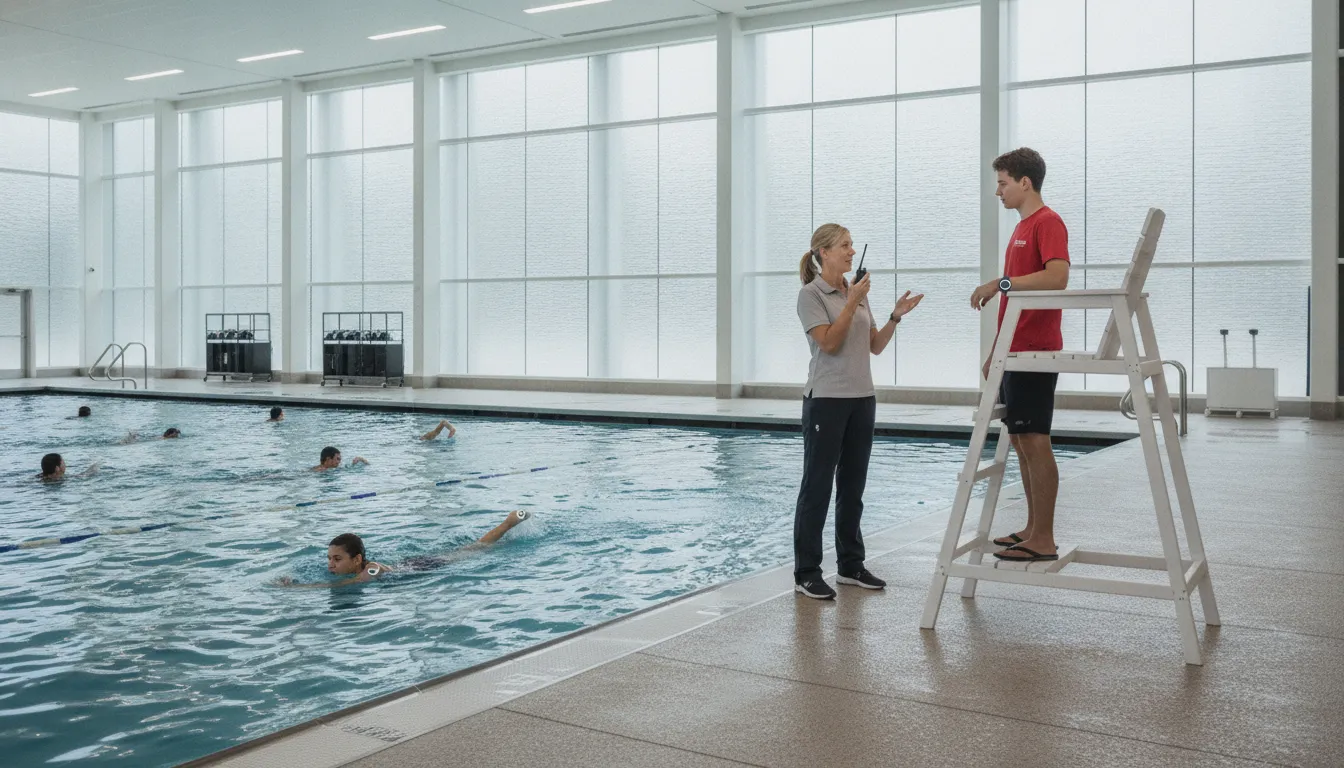
At a supervised aquatic facility, an alarm has to do more than make noise. It must help the right staff recognize a possible problem and respond while lifeguards continue active surveillance. Drowning can happen in seconds and is often silent, according to the CDC, so facility leaders should evaluate alert systems as one part of a broader safety plan.
A pool drowning alarm system for a supervised facility is an active detection and staff-alert layer that can signal a possible submersion or other defined event. It serves a different job from home-use alarms that monitor access, and from passive barriers such as fencing, which help prevent unsupervised entry.
The practical question is not which category sounds most advanced. It is which safety job each category can support, who receives the alert, and what trained people do next. Start with a clear definition of the system category before comparing active alerts with home-use alarms and passive safeguards.
What Is a Pool Drowning Alarm System?
A pool drowning alarm system is technology designed to identify a possible drowning event or prolonged submersion and notify people who can respond. For an aquatics facility, that usually means an active staff-alert system that works alongside lifeguards, established supervision, and an emergency action plan. It is one category within the broader range of drowning prevention technology options.
The distinction matters because the phrase can describe very different tools. Some home-use alarms monitor access to a pool or detect movement in the water, then sound an alert nearby. Passive safeguards, such as fencing and controlled gates, are intended to limit unsupervised access. An active facility alert system instead focuses on notifying staff during supervised aquatic operations, where a fast, coordinated response is the goal.
The need for layered protection is grounded in how drowning occurs. The CDC states that drowning can happen in seconds and is often silent. It recommends close and constant adult supervision near water, and advises adults to supervise children closely even when lifeguards are present. A detection-and-alert system should therefore be evaluated as a support for human supervision, not as a replacement for it. See how these principles fit into broader commercial pool safety systems.
In a supervised facility, the system may combine swimmer wearables or other detection technology with a central hub and staff alerts. WAVE's GUARDian Hub system is designed around that model, helping route an alert to the people responsible for assessing the situation and taking action. The exact fit depends on the facility's water environment, staffing model, swimmer population, and response procedures.
Drowning alarm systems serve different safety jobs. Home-use alarms and barriers help control access, while active staff-alert technology adds detection and communication support to a supervised aquatic environment.
Which Pool Alarm Categories Serve Different Safety Jobs?
A pool safety device should be judged by the moment it is meant to address. Active staff-alert technology is built to communicate a possible swimmer emergency to people responsible for supervision. Home-use alarms and passive barriers address a different problem: limiting unsupervised access when a pool or other water area is not actively managed. Treating these categories as interchangeable can leave a gap between detection, notification, and response.
A complete safety plan matches the tool to the risk: active alerts support staff during supervised swimming, while alarms and barriers help control access when people should not enter the water.
| Category | Signal | Primary user | Expected response | Key limitation |
|---|---|---|---|---|
| Active staff-alert technology | Detection data is sent to designated staff through an alert pathway. | Lifeguards, attendants, and facility response teams | Staff investigate, follow the facility emergency action plan, and provide assistance when needed. | It supplements supervision; staff still need training, clear roles, and a practiced response. |
| Home-use alarms | An alarm can indicate activity at an access point or in the water, depending on the device. | Property owners or responsible adults | An adult checks the area and prevents or interrupts unsupervised access. | An alert does not itself provide supervision or ensure a timely rescue. |
| Passive barriers | There is no electronic signal. A fence, gate, lock, or controlled doorway creates physical separation. | Owners, operators, and maintenance staff | Keep the barrier closed, locked, and maintained so unauthorized access is harder. | Barriers reduce access risk but do not detect a swimmer in distress once water access occurs. |
The CDC recommends four-sided fencing at least four feet high that fully encloses a pool, illustrating how physical separation can serve as a foundational safeguard (CDC guidance). It also lists locks or alarms for windows and doors as access safeguards, which reinforces the role of home-use alarms as access-control tools rather than staff-notification systems (CDC pool safety guidance). A systematic review likewise grouped prevention approaches into education, swimming lessons and water safety, and pool fencing, showing why layered measures matter (systematic review).
For an aquatics facility, the practical question is not which category wins. It is which risks exist during operating hours, who receives an alert, and what response follows. Active staff alerts can add a detection layer to supervised operations, while barriers and access alarms remain useful for controlling entry outside those operations.
How Do Active Staff Alerts Work in a Supervised Facility?
Active staff alerts connect swimmer or lifeguard wearables to a central hub, then route a possible submersion event to the people responsible for response. This model is designed to add information to an existing safety program, not to replace lifeguard observation, established procedures, or human judgment.
In a typical deployment, a swimmer wears an approved sensor, while lifeguards may use dedicated tags. The wearable monitors for a defined condition, such as submersion, and communicates with the facility hub. WAVE's GUARDian Hub (w3000) provides the central connection between wireless devices, facility alerts, and management software. The exact configuration depends on the site, equipment, and operating plan.
The research literature describes this general approach as a supplement to pool monitoring. In one evaluation, swimmer-worn headbands sent alerts to vibrating staff bracelets and audible alarms when submerged for a period of time. The study did not present the technology as an independent rescue system. Instead, it examined whether an additional alert channel could support staff monitoring in a busy pool environment. Read the study on wearable drowning-detection alerts.
An active alert system detects a configured risk signal, routes it through a hub or software layer, and gives staff a prompt to investigate. Lifeguards still verify the situation and lead the appropriate response.
From detection to verification
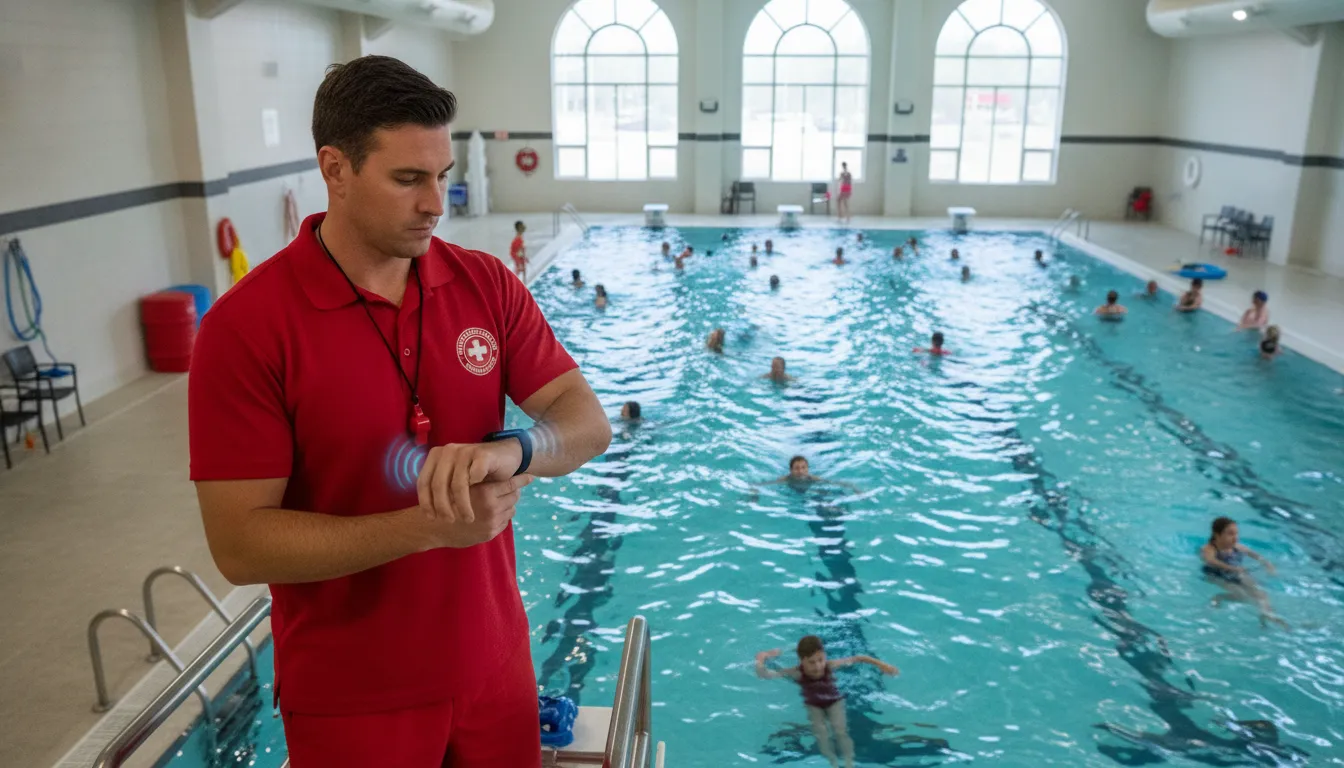
When an alert is generated, the first priority is locating and assessing the swimmer. A vibrating bracelet can reach a staff member scanning the water. An audible signal, spoken announcement, siren, or visual indicator can provide broader facility awareness when configured for the site. These signals should direct attention, not trigger an automatic assumption about what happened.
Verification matters because not every alert represents a drowning emergency. In the cited study, staff reported risky underwater play and leaving the pool area among the leading reasons for alerts. That finding illustrates why trained personnel remain essential. They interpret the signal, check the water and surrounding deck, communicate with other staff, and follow the facility's emergency action plan when intervention is needed. The authors concluded that the evaluated system may supplement lifeguard monitoring of large groups of children in pools.
For directors comparing pool drowning detection systems, the practical question is therefore not whether an alarm replaces supervision. It is whether the alert path fits the facility's staffing model. Directors should also confirm that recipients can verify alerts promptly and that the system supports a clear response workflow. Reviewing the GUARDian Hub system and its available staff-alert configuration can help operators frame that evaluation around real pool operations.
What Should Aquatics Directors Evaluate Before Choosing a System?
A useful evaluation looks beyond whether an alarm sounds. Directors should confirm who receives the alert, what condition triggers it, how staff respond, and whether the system fits the facility's water, construction, training, maintenance, and reporting needs.
Start with the response pathway. Identify the people who must receive an alert during every operating period, such as lifeguards, supervisors, front-desk personnel, or security staff. Then define what happens next: who verifies the location, who clears the area, who begins rescue procedures, and who documents the event. A system that detects a concern but does not reach the right responder quickly may not fit the facility's operating model.
Next, evaluate the detection approach. Camera-based systems use computer vision and deep learning to identify pool drowning situations, while wearable systems can monitor the status of participating swimmers and send alerts through connected staff devices. A 2024 review describes embedded systems as enabling real-time monitoring, identification of dangerous situations, and prompt alerting, but the technology still needs a clear human response plan. Compare how each approach handles visibility, coverage, privacy, swimmer participation, and the facility's normal activities. See WAVE's swimmer safety alert systems guide for a broader selection framework.
Water and construction conditions also matter. Ask whether the system can operate in the facility's typical clear, dark, or murky water, and whether installation requires cameras, wiring, permanent construction, or changes to the deck. For a wireless wearable approach, review the fit and use of AquaSense swimmer wearables, lifeguard tags, and the GUARDian Hub system.
Test the workflow before committing
Request a realistic demonstration during lessons, open swim, or other high-activity periods. Check alert recipients, escalation methods, false-alert handling, battery or charging routines, equipment cleaning, replacement procedures, onboarding for seasonal staff, and refresher training. Ask what reporting and software tools retain, including alerts, device status, and response records. Hub Management Software can be reviewed as part of that operational assessment. The best choice is one staff can use consistently, maintain properly, and integrate into existing emergency action plans without treating technology as a substitute for supervision.
Finally, document acceptance criteria before procurement. Include coverage, staff usability, training time, maintenance ownership, data access, and support expectations. This turns a demonstration into a defensible facility decision rather than a purchase based only on a product feature list.
Why Lifeguard Support Still Matters With Technology
A pool drowning alarm system can extend a facility's awareness, but it cannot replace trained people watching the water. Lifeguards and other designated staff still need clear sightlines, defined zones, reliable communication, and the authority to act. The CDC advises that adults supervise children closely even when lifeguards are present, reinforcing that technology belongs within a broader safety program, not outside it. The CDC's drowning-prevention guidance provides that foundational context.
Technology adds another response layer by helping alert staff to a potential problem. Lifeguards, supervision, emergency procedures, training, and CPR readiness remain essential to deciding what happens next.
That human response begins before an alert occurs. Facilities should maintain an emergency action plan that assigns responsibilities, defines how staff communicate, and explains how a suspected submersion is escalated. Regular drills can reveal practical gaps, such as an alert recipient who cannot hear a signal from a busy deck or a responder who is unsure which entry point to use.
Training must also cover recognition and immediate action. The CDC recommends continuous, close supervision of swimmers and advises pool users to learn how to recognize and respond to a swimmer in distress and perform CPR. Read the guidance on continuous supervision and CPR readiness when reviewing facility procedures.
Research on WAVE detection technology describes it as a supplement to pool monitoring, and the study authors concluded that the evaluated system may supplement lifeguard monitoring of large groups of children. That distinction matters: an alert can prompt attention, but staff must assess the situation, reach the swimmer, provide care, and activate the facility's emergency plan. To see how that additional layer fits together, review how the GUARDian system works.
Where Do Home-Use Alarms and Passive Barriers Fit?
Home-use alarms, access controls, doors, and fencing address a different point in the safety chain than an active staff-alert system. They help manage who can reach the water and when, which is especially important when a child may approach an unattended pool area. In a supervised facility, however, the operational question is often what happens after a swimmer is already in the water and staff need a timely signal.
Home-use alarms and passive barriers help control access to water. Active detection technology supports staff response during supervised aquatic activities. Facilities may need both types of protection, but they should not treat them as interchangeable.
Access controls and barriers reduce unsupervised entry
The CDC recommends four-sided fencing that fully encloses a pool and separates it from the house, with self-closing and self-latching gates. It also recommends closing and locking doors that provide access to water after swim time. Locks or alarms on windows and doors can add another access safeguard. These measures are designed to create separation and make unintended entry more difficult, not to monitor every swimmer during an organized activity.
Those principles can inform facility planning too. Operators should review gates, doors, restricted areas, and staff-only access points as part of their broader safety program. Fencing and access controls can complement commercial pool safety systems, particularly around periods when the pool is closed or activity is not actively supervised.
Active alerts serve a different response need
A facility evaluating a pool drowning detection system is usually addressing an in-water monitoring and response workflow. WAVE's model uses wearable sensors, a central hub, and staff alerts as an additional layer for supervised environments. Research evaluating WAVE detection technology described it as a supplement to pool monitoring. In that evaluation, swimmer-worn devices sent alerts to vibrating staff bracelets and audible alarms after submersion for a period of time. See the study at PMC.
That distinction is not a criticism of home-use alarms or passive barriers. Each category has a useful job. Access controls help prevent an unobserved approach to the water, while active alerts can help staff focus attention on a possible in-water event. The strongest plan assigns each measure a clear role alongside supervision, training, and an established emergency response process.
How Can a Facility Build a Practical Alert Strategy?
A useful alert strategy connects detection technology to the people, procedures, and training already responsible for swimmer safety. The goal is not to create a standalone promise of protection. It is to add a clear, practiced response layer around supervision, especially when staff are monitoring many swimmers or changing activities.
A practical facility alert strategy defines where detection is needed, who receives each alert, what staff do next, and how the team will test and improve the process. Technology works best when it strengthens an existing safety program rather than attempting to replace it.
- Define risk and coverage. Map the pools, lanes, programs, water conditions, and operating periods where an alert could support staff. Identify activities that make continuous observation more difficult, such as youth lessons, open swim, or crowded programming. CDC guidance emphasizes continuous, close supervision, so use an alert system to reinforce that responsibility, not reduce it. A facility evaluating a GUARDian Hub system should also determine which swimmers or staff need compatible wearables and tags.
- Map alert recipients and escalation. Decide who needs the first signal, who backs that person up, and how an alert reaches supervisors or other designated responders. The evaluated WAVE system was designed as a supplement to pool monitoring, with alerts reaching staff through wearable and audible channels: the study describes submerged swimmer-worn devices sending alerts to vibrating staff bracelets and audible alarms. Your plan should account for coverage gaps, noise, distance, and staff handoffs.
- Align the alert with response procedures. Write the immediate actions in the facility's emergency action plan, including visual confirmation, clearing or securing the area, rescue response, communication, and documentation. Staff should know how to recognize and respond to a swimmer in distress and how to perform CPR, as the CDC recommends. An alert is a prompt to act, not a diagnosis or a substitute for judgment.
- Pilot, train, and review. Test the system during realistic operating conditions before expanding deployment. Train each role on alert meaning, equipment use, escalation, and reset procedures. In the WAVE evaluation, authors concluded that the technology may supplement lifeguard monitoring of large groups of children in pools, while staff feedback also informed usability improvements. Review alert patterns, response timing, false or expected alerts, coverage gaps, and staff observations, then update training and procedures.
Facilities can compare swimmer wearables and lifeguard tags with their staffing model, then use Hub Management Software to support system management and review.
Schedule a free consultation to discuss your facility's alert strategy
Frequently Asked Questions
What is the best pool water alarm?
The best option depends on the safety job. For a supervised facility, choose a system that detects a concerning event and alerts assigned staff through a defined response workflow. Home-use alarms and access barriers serve a different purpose. Compare detection method, alert recipients, water conditions, installation needs, and staff training rather than relying on a generic ranking.
How much does a pool alarm system cost?
Cost varies by system type, number of monitored swimmers or zones, alert hardware, software, installation, and support. Ask vendors for a complete scope and recurring costs instead of comparing a device price alone. A facility should also account for training, maintenance, replacement policies, and how the system fits its existing emergency action plan. Avoid choosing on price before confirming operational fit.
Do anti-drowning bracelets work?
Wearable systems can provide an additional detection-and-alert layer when they are matched to the facility workflow. In a published evaluation, a wearable system sent alerts to vibrating staff bracelets and audible alarms after submersion for a period, and the authors described it as a supplement to lifeguard monitoring. Read the study at PMC. Wearables do not replace supervision or guarantee safety.
Are active staff alerts different from home-use pool alarms?
Yes. Home-use alarms generally support access control or signal activity around a private pool, while active staff-alert systems are designed to route detection information to trained personnel in a supervised environment. The CDC recommends locks or alarms for windows and doors as access safeguards, along with four-sided fencing where appropriate. See the CDC guidance at CDC Healthy Swimming.
Can a pool drowning alarm system replace lifeguards?
No. A pool drowning alarm system should support, not replace, lifeguards and other responsible supervisors. The CDC recommends continuous, close supervision and advises adults to learn how to recognize and respond to a swimmer in distress, including CPR. Review the response plan, train staff, and treat technology as another layer of protection.
Ready to Plan Your Facility's Alert Strategy?
A clear alert strategy can help your team evaluate how detection technology fits alongside supervision, training, and emergency procedures. WAVE can help you discuss the needs of your supervised aquatic facility and identify practical next steps.
