
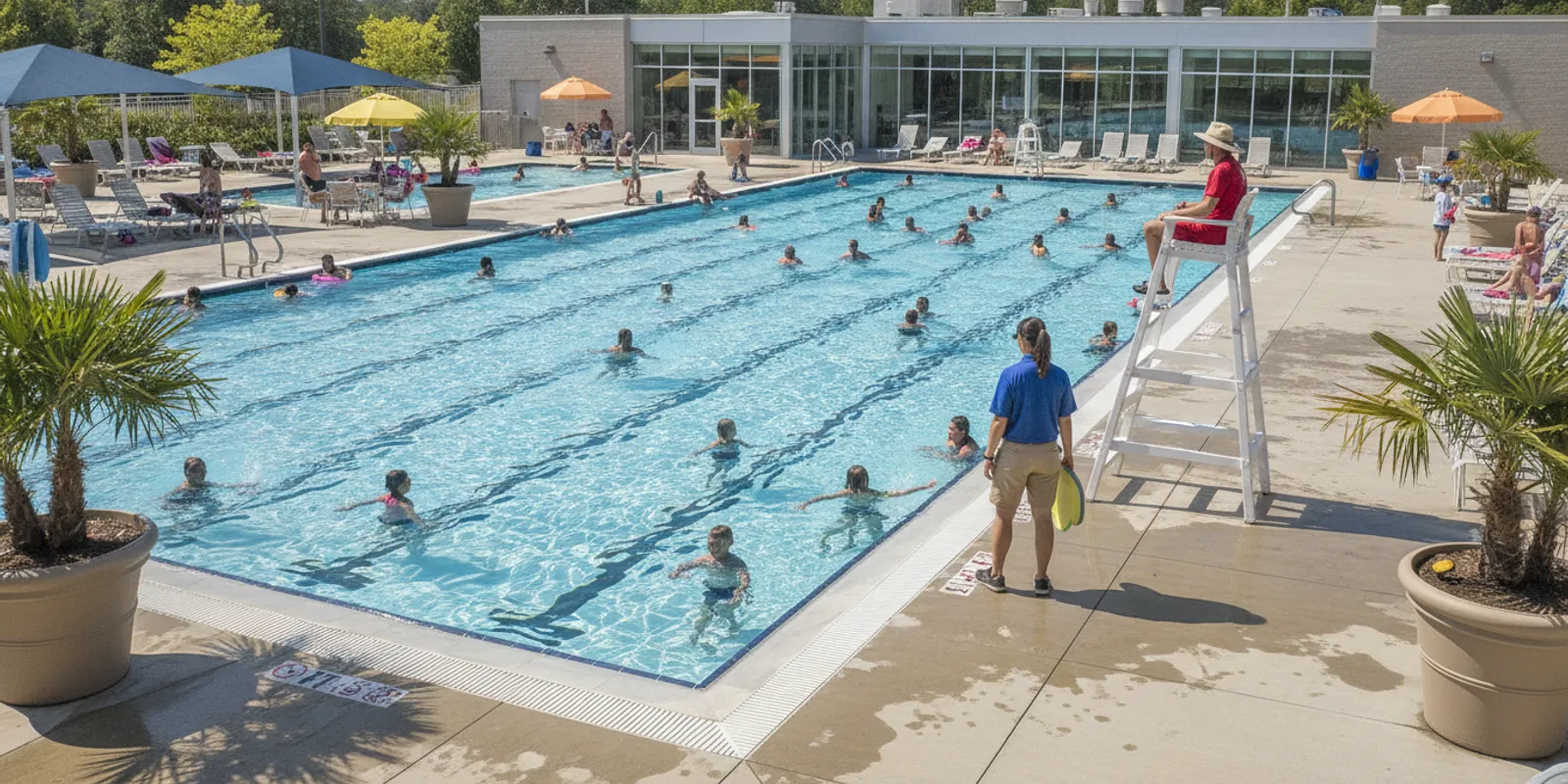
A municipal pool safety system is not a single device. It is the combination of trained staff, clear procedures, suitable equipment, and reliable communication that helps a public facility recognize an emergency and respond. For aquatics directors and municipal leaders, the practical question is how to improve coverage without disrupting daily operations or treating technology as a substitute for lifeguards.
A strong municipal pool safety system starts with staffing, surveillance, and a practiced emergency plan. Technology can add another layer by detecting defined events and alerting staff, but it cannot replace lifeguard observation, training, or emergency response procedures. Choose tools only after identifying the facility's real operating needs.
What belongs in a municipal pool safety system?
Think in layers: prevent avoidable hazards, maintain active supervision, communicate quickly, and practice what staff will do when an incident occurs. Equipment should fit into those layers rather than operate as a stand-alone promise of safety.
Municipal aquatic facilities must coordinate people, spaces, schedules, and procedures. One pool may host public swim, lessons, team practice, and camps in the same day. Each activity can change traffic patterns and attention demands. A useful plan makes the safety responsibilities clear across those changing conditions.
Begin by documenting what the facility already uses. Include staff assignments, opening and closing checks, deck rules, rescue equipment, first-aid and communication tools, emergency action plans, incident reporting, and maintenance routines. Then identify where a missed signal, unclear handoff, or delayed notification could make response harder. This is more useful than starting with a product list.
Many plans can be grouped into four connected layers:
- Prevention: Facility rules, access controls, hazard checks, and clear patron communication.
- Supervision: Qualified staff, defined zones, active scanning, and relief procedures.
- Detection and communication: Staff observation plus suitable tools that can signal a defined event and notify the right people.
- Response and learning: Emergency action steps, available equipment, practiced roles, incident documentation, and follow-up review.
These layers must work together. An alert is not useful if nobody is assigned to receive it or knows what to do next. Likewise, a written procedure is difficult to execute if staff have not practiced their roles. The CDC's Inspection-Based Checklist for Pool Operators is a useful reference for pool safety education and technical assistance; use it as a planning aid alongside the applicable state and local requirements, not as a replacement for them.
For a broader review of equipment categories and facility considerations, see this public pool safety guide and the commercial pool safety equipment checklist.
How should a municipality assess its current coverage?
Assess the facility during real operating conditions, not only from a floor plan. Walk the deck, ask staff to describe their assignments, and trace how an observed concern becomes an alert, a response, and a documented follow-up. Record specific gaps before comparing solutions.
A coverage assessment helps leaders separate an equipment problem from a staffing, workflow, or communication problem. It also creates a defensible basis for procurement: the municipality can explain what need it is addressing, who will use the solution, and how success will be evaluated. Include aquatics staff in the assessment because they understand the daily rhythms that a procurement specification may miss.
Map activities, spaces, and transitions
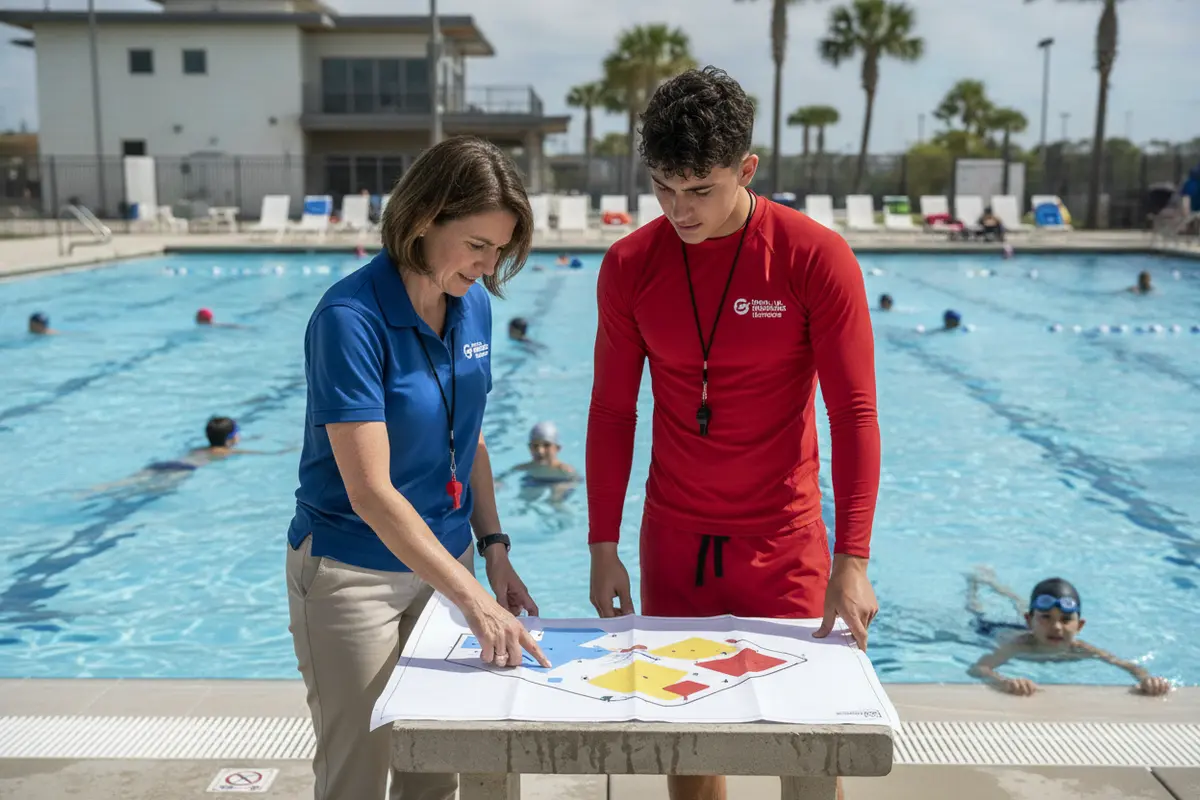
Sketch the facility and note pools, shallow areas, slides or features, entry points, blind or noisy areas, deck access, and staff positions. Mark the activities scheduled in each area and the times when one program hands the space to another. Consider changes in attendance, daylight, weather, water clarity, and seasonal staffing as relevant to the particular facility. The objective is not to assume that every site has the same risk; it is to make local conditions visible.
Follow the communication chain
For a sample scenario, trace each step: Who first notices a concern? Who initiates a response? How are other guards, supervisors, or responders notified? Who keeps the surrounding area clear and communicates with patrons? What happens if the primary staff member is occupied or a device is unavailable? A short tabletop exercise can expose unclear handoffs before an emergency occurs.
Write down where the chain slows or becomes ambiguous. A device may help address a detection or notification gap, while a revised zone plan or refresher practice may better address another. Do not treat technology as a cure for every issue. For guidance on structuring response roles, review this aquatic emergency action plan review.
Turn the review into a phased plan
Summarize findings in a short register with four fields: the observed gap, the conditions when it occurs, the current response, and the person responsible for follow-up. Rank items by operational importance and distinguish immediate procedural fixes from equipment questions that need procurement review. This keeps an urgent staff refresher from being delayed while a longer purchasing decision is underway.
For each proposed change, name an owner and a review date. A pilot can focus on a single pool, program, or shift if that provides a representative test and fits municipal procurement rules. Decide in advance what evidence staff will collect, how feedback will be recorded, and who may approve changes to the workflow. At the end, compare observations with the original gap rather than relying on general impressions.
Share the results with aquatics leadership, risk management, and procurement staff in a format they can use. A clear record helps the municipality explain why it selected a particular intervention, what limitations remain, and what the next review should address.
Which safety technologies serve different roles?
Compare systems by the job they perform, the conditions where they work, and the staff action they prompt. A monitoring or alerting product should add a defined capability to the facility's plan; it should not be described as an independent replacement for supervision or rescue.
Municipal buyers may encounter cameras, wearable sensors, alarms, communication devices, and passive barriers. Those tools do different jobs. A comparison should distinguish the event a technology is designed to detect from the broader outcome the facility hopes to achieve. Ask vendors to demonstrate their system under conditions relevant to the site and explain what staff will see, hear, or feel when it sends an alert.
| Approach | Role in the plan | Questions for municipal buyers |
|---|---|---|
| Staff observation and supervision | Continuous human oversight and decision-making | Are assignments, zones, reliefs, and escalation steps clear and practiced? |
| Camera-based monitoring | Visual monitoring or event detection in suitable environments | What installation is required? How does water clarity, lighting, and site layout affect operation? |
| Wearable swimmer sensors | Wireless detection and alerting tied to swimmers wearing devices | How are wearables issued, fitted, collected, maintained, and incorporated into staff response? |
| Communication and alert devices | Move a notification to designated staff or responders | Who receives alerts, how are they acknowledged, and what backup exists? |
| Passive barriers and access controls | Reduce access to a space or hazard when appropriate | Which site-specific hazards do they address, and do they fit public-facility operations? |
WAVE's approach is a wearable, wireless drowning-detection layer for supervised aquatic environments. Its system uses swimmer wearables and facility equipment to send alerts to staff; WAVE also describes lifeguard water-entry alerts as part of its offering. That is a specific role in the response chain, not a replacement for lifeguards. Learn more about the GUARDian Hub (w3000) and swimmer equipment before deciding whether those functions match the facility's documented needs.
For systems that rely on imagery, ask how performance changes with the facility's water and lighting conditions, what infrastructure is required, and how images are handled. For wearable approaches, clarify how the facility will distribute and account for devices, what happens when a swimmer is not wearing one, and how alerts are routed. Neither approach removes the need to supervise every swimmer according to the facility's policies.
How can wearable alerts fit into daily municipal operations?
Wearable alerts work best when issuance, staff notifications, response assignments, and end-of-shift checks are part of ordinary operations. Decide who owns each step, test the workflow, and train for alerts as well as for equipment or connectivity issues.
A wearable system is not simply a device placed near the pool. The facility needs an operating routine that makes participation understandable for staff and patrons. Before launch, determine where equipment will be stored, who will prepare it, how staff explain its use, and how returned items will be checked and managed. Keep those tasks practical for the busiest shift, not only for an ideal day.
Next, define alert ownership. Identify which team members receive each type of notification, what an alert means, how staff acknowledge it, and what action is expected. Consider how the process changes during lessons, open swim, swim team practice, and staff breaks. Make sure a notification does not distract a guard from active surveillance; clarify who takes over a zone if a staff member must respond.
Build a pilot around a representative operating period. Train the affected staff, test alert routing, rehearse the response, and document issues. Ask staff whether signals are recognizable amid the facility's normal sound and activity. Review how the system behaves in the actual water and at relevant operating locations. A pilot should check workflow and practical fit; it should not be presented as proof that a facility is risk-free.
Establish an ongoing routine that covers opening checks, device distribution and return, charging or battery expectations as applicable to the selected product, cleaning, reporting a fault, and escalating unresolved issues. WAVE describes AquaSense as a non-tethered wearable with a multi-year battery and no daily recharging; confirm current product details and operating requirements with the supplier as part of procurement. Document the responsibilities in staff procedures and update them if the facility changes its programs or layout.
Training is central to making any alert workflow usable. The National Recreation and Park Association's aquatics training article notes that regular training helps maintain staff skills and supports patron safety. Treat product onboarding as one component of a wider practice plan, not a replacement for the municipality's required qualifications and emergency-response training.
What should a municipal procurement team ask vendors?
Start with documented requirements, then ask each vendor to show how its system satisfies them. Compare the full operating model: deployment, staff workflow, maintenance, support, data handling, and recurring costs, not just a device's headline feature.
Public procurement must be understandable to both facility staff and decision-makers who may not work on deck. A concise requirements document helps keep a review objective. Describe the operating environment, the problem to solve, required integrations or alerts, deployment constraints, staff training needs, and how the municipality will evaluate a proposal. If the facility has multiple sites, clarify which needs are shared and which require a site-specific configuration.
Use questions such as these during demonstrations and written evaluations:
- Detection: What event does the product detect, and what does it not claim to detect? What conditions or user actions affect its operation?
- Alert path: Who receives a signal, by what means, and what happens if the intended recipient does not acknowledge it?
- Staffing: What staff roles are required during routine use and during response? Does the vendor clearly state that technology supports, rather than replaces, lifeguards?
- Deployment: What construction, permits, facility downtime, network access, or other site preparation is needed?
- Operations: What routine checks, cleaning, software updates, battery management, and replacement processes are needed?
- Training and support: What onboarding is included, how are new staff trained, and how does the facility report a system issue?
- Privacy and records: What information is collected, who can access it, how long is it retained, and what terms govern its use?
- Costs: What recurring subscription, equipment, accessories, maintenance, renewal, and payment terms apply over the full contract?
- Evaluation: Can the municipality run a structured demonstration or pilot using written criteria and a defined review period?
Ask vendors to distinguish published product capabilities from assumptions about outcomes. Request plain-language documentation and confirm that contract terms align with the municipality's procurement rules. Include the staff who will use and maintain the system in the review. A polished demonstration cannot answer every question about a busy facility, so consider a site-specific trial when procurement rules and vendor arrangements allow.
WAVE provides product information for its drowning-detection system demonstration checklist and system options. For subscription details, review the current WAVE pricing page and request written terms; avoid relying on older figures or assumptions when preparing a municipal budget.
How can municipalities plan costs and funding responsibly?
Budget for the total cost of owning and operating a solution, not only its initial price. Separate confirmed funding from possible funding, verify eligibility and deadlines with the grantmaker, and plan for staff time, renewals, maintenance, and replacement.
Municipal budgets often involve several departments and approval steps. Put the safety need in operational terms first: what issue the investment addresses, which locations are in scope, who will manage it, and how the municipality will review implementation. Then compare options using the same time horizon and cost categories. This approach makes a subscription and a capital purchase easier to evaluate on equal footing.
A full-cost worksheet can include:
- Initial equipment or deployment costs, if any.
- Monthly or annual subscriptions and contract length.
- Accessories, wearables, tablets, connectivity, or storage requirements.
- Staff time for training, issuance, checks, and administration.
- Maintenance, software updates, support, replacement, and renewal terms.
- Site preparation, procurement, and any facility downtime.
- Costs for a pilot and the process for scaling or ending it.
Use written vendor quotes and the municipality's own labor and procurement assumptions. Do not treat a possible grant as guaranteed revenue. A proposal should still make operational sense if an application is unsuccessful or an award arrives later than planned. If outside funding may be appropriate, confirm the grant's purpose, applicant eligibility, matching requirements, allowable costs, application window, and reporting obligations directly with the official program administrator.
WAVE has a FAQ for product questions. Verify every funding program independently, and have the municipality's grants or finance team confirm whether a particular public entity and proposed expense qualify. A grant-aware plan should explain the project clearly without assuming that a funding award will be made.
How do training, maintenance, and review keep the plan usable?
A written system matters only if the team can use it on an ordinary shift and under pressure. Assign an owner, practice essential response steps, check equipment on a schedule, and review incidents or near misses for lessons that may require a procedural change.
Municipal pools experience staff turnover, seasonal hiring, program changes, and shifts in facility use. Procedures should therefore be easy to find and repeatable. Assign an owner for the safety plan and identify who updates contact lists, training records, equipment checks, and vendor information. Keep a concise quick-reference version available to staff while maintaining the complete approved procedure in the municipality's normal document system.
Training should cover the actual facility workflow: staff positions, zone coverage, reliefs, communication signals, emergency roles, and the use and limits of any technology. New staff need a clear orientation; returning staff benefit from refreshers and practice when procedures or equipment change. The NRPA source above supports regular training as a way to maintain staff skills; follow applicable local rules and recognized aquatic training requirements for qualifications and practice frequency.
Maintenance planning should name the person responsible for each check and how an issue is recorded and escalated. Include a process for removing a malfunctioning item from service, contacting support, communicating a temporary procedure, and confirming return to service. Keep backup communication and response procedures available so staff do not mistake an unavailable tool for a reason to pause established supervision.
After drills, system tests, incidents, or near misses, gather observations from the people who performed the work. Ask what was clear, what was delayed, and what needs adjustment. Record decisions and owners, then update the procedure and retrain affected staff. Review whether the technology is still suitable when the pool layout, operating schedule, water conditions, or staffing model changes. This creates a cycle of planning, practice, review, and correction instead of a one-time purchase.
Facilities can also revisit their broader swimmer monitoring system options and consult the WAVE FAQ when product questions arise. Product resources can inform the review, while the municipality remains responsible for its own operating procedures and decisions.
Frequently Asked Questions
Municipalities should choose a safety system around the facility's documented needs, local requirements, and staff response plan. The answers below address common questions about technology, purchasing, and operations; site-specific decisions should involve aquatic leadership and the appropriate municipal authorities.
Does a municipal pool safety system replace lifeguards?
No. Technology can support supervision by adding a detection or notification layer, but it does not replace lifeguard observation, staffing, training, or response procedures. Keep supervision assignments and emergency roles clear whether a facility uses technology or not.
What should a municipality assess before buying pool safety technology?
Document the facility layout, programs, staffing and coverage procedures, communication chain, operating conditions, and known process gaps. Then define what a proposed product must do, how staff will respond to its alerts, and how the municipality will evaluate fit.
Are wearable systems suitable only for clear water?
Wearable sensing and camera-based monitoring use different approaches, so buyers should ask vendors about the operating conditions and limitations of each product. WAVE describes its wearable system as functioning in clear and dark or murky water; confirm the current product specification and test suitability for the facility's conditions.
How should municipalities compare subscription and upfront costs?
Compare total costs over the same period and include equipment, recurring fees, contract terms, accessories, staff time, maintenance, training, and replacement. Use written quotes and confirm current pricing directly with the vendor rather than budgeting from outdated information.
Can grant funding pay for municipal pool safety technology?
Eligibility depends on the specific grant program, applicant type, project purpose, and allowable costs. Verify requirements, deadlines, matching funds, and reporting duties with the official grantmaker and municipal grants staff before making funding part of the project budget.
What should a pilot of an alert system measure?
Set written criteria for deployment, alert routing, staff understanding, response roles, routine checks, and fit during representative programs and shifts. Record what works and what needs correction. A pilot evaluates workflow and suitability; it cannot establish that a facility is free of risk.
A well-planned municipal pool safety system combines clear supervision, practiced procedures, appropriate equipment, and communication that staff can act on. Start with the facility's needs, involve the people who will operate the plan, and review the system as conditions change.
