
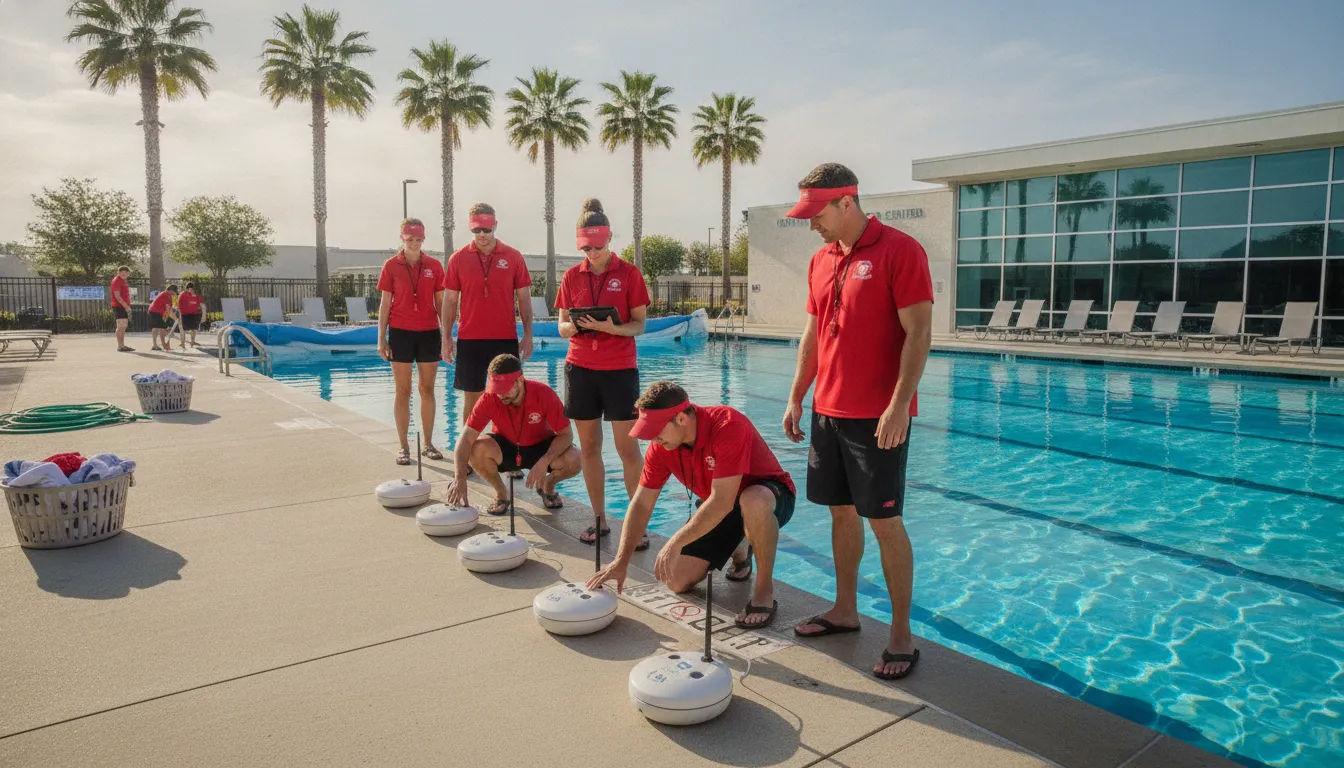
Opening a seasonal pool, camp waterfront, or municipal swim area safely takes more than filling the water and posting a schedule. Leaders need a documented plan for inspecting rescue gear, testing barriers and alerts, preparing lifeguards, and maintaining every safety layer. A deliberate approach to seasonal pool safety equipment helps staff identify problems before the first swimmer arrives.
The most effective plan connects equipment readiness with staff readiness. Physical tools, trained lifeguards, clear procedures, and drowning-detection technology each serve a different purpose. Together, they help facilities support attentive supervision throughout a short, demanding operating season. The sections below provide a practical framework for planning, opening, operating, and closing safely.
Build your seasonal pool safety equipment plan
A seasonal pool safety equipment plan should identify every required safety layer, assign an owner to each item, and set inspection and testing deadlines before opening day. It should cover barriers, rescue and medical gear, staff training, emergency procedures, and any digital alert technology used to support lifeguards.
Start by reviewing last season's records and listing every area that needs attention. Note damaged or missing equipment, maintenance concerns, staffing changes, and lessons from drills or incidents. Then turn those findings into a timeline with specific owners and completion dates. This prevents important tasks from disappearing in the rush to open.
Inventory every safety layer
Check life rings, reaching poles, rescue tubes, life jackets, first aid supplies, oxygen equipment, and AEDs. Inspect each item for wear, damage, missing parts, or expired components. Rescue equipment should be clearly located and easy for staff to reach. Replace questionable items before opening rather than relying on gear that may fail during an emergency.
Include fences, self-closing gates, latches, deck surfaces, depth markers, and posted rules in the same inventory. Barriers help limit unauthorized access, while clear signs help swimmers understand where and how to enter safely. Review local codes and operating requirements because the rules that apply to one facility may not apply to another.
Prioritize budget and ownership
Set priorities by considering both the likelihood and potential consequence of failure. Required barrier repairs, missing rescue gear, expired medical supplies, and staff certification needs should be addressed before optional improvements. When reviewing digital options, learn how drowning-prevention technology can support supervision without replacing lifeguards.
Assign one accountable owner to every task. A site lead might oversee gates and deck conditions, a head guard might manage rescue gear, and a safety or technology lead might test medical supplies and alerts. Clear ownership makes readiness measurable and gives managers a simple way to confirm that work is complete.
Follow a clear opening sequence
- Confirm access control: Inspect fences, gates, latches, locks, signs, and the deck perimeter.
- Inspect rescue and medical gear: Check condition, placement, supply levels, batteries, and expiration dates.
- Test alert systems: Verify that all configured hubs, tags, bracelets, and facility alerts communicate as expected.
- Train and drill staff: Practice emergency procedures with the equipment that guards will use on shift.
- Document readiness: Record completed checks, unresolved issues, owners, and final approval before opening.
This sequence gives managers a repeatable path from inspection to approval. It also provides a useful record for weekly and midseason reviews. For a broader view of facility-level considerations, review WAVE's guide to choosing a commercial pool safety provider.
Evaluate equipment before opening day
Before opening, evaluate equipment by inspecting its physical condition, confirming correct placement, and testing how it performs during realistic drills. Do not treat presence as proof of readiness. A life ring, gate latch, AED, or alert device only strengthens the safety plan when staff can rely on it and use it correctly.
Inspect fences, gates, decks, and signs
Walk the full perimeter instead of checking only the main entrance. Look for loose posts, damaged sections, gaps, rust, vegetation, or stored objects that could undermine a barrier. Test every gate to confirm it closes and latches correctly. Review the CDC's drowning-prevention guidance while assessing the facility's layered approach.
Inspect deck surfaces for loose materials, cracks, and trip hazards. Confirm that depth markers and safety signs remain visible and accurate. Correcting these issues before staff orientation gives guards a safer environment in which to train and helps managers avoid hurried repairs after opening.
Check rescue and medical gear
Inspect rescue tools one by one. Look for cracked, weakened, frayed, or missing components, and confirm that each tool is stored in its designated location. Check life jackets for damage and fit. Review first aid, oxygen, and AED supplies for expiration dates, battery condition, and completeness according to the facility's procedures.
Next, use drills to verify access and usability. Staff should be able to locate and deploy equipment without confusion. A written checklist is useful, but a realistic response drill reveals problems that a visual inspection can miss, including blocked access, unclear roles, and unfamiliar equipment.
Test drowning-detection technology and wearables
If the facility uses WAVE, confirm that AquaSense swimmer wearables, lifeguard tags, alert bracelets, the GUARDian Hub, and configured software are ready for operation. Test alerts and communication across the actual supervised area. WAVE's wearable, wireless approach can work in clear or dark and murky water because it does not depend on camera visibility.
Technology should remain an additional layer of swimmer protection, not a substitute for lifeguards, barriers, training, or rescue equipment. Staff must understand what an alert means, where to respond, and how to follow the facility's emergency action plan. Managers can also review WAVE's system and subscription options when planning the season's budget.
| Equipment category | Pre-opening check | Suggested owner | Timing |
|---|---|---|---|
| Pool barriers | Test gates and inspect the full perimeter | Site lead | Early pre-season |
| Rescue gear | Inspect condition, placement, and access | Head guard | Before staff drills |
| Safety technology | Charge, connect, and test configured alerts | Technology lead | Before staff drills |
| Medical supplies | Check completeness, batteries, and dates | Safety lead | Before final approval |
Pair equipment readiness with staff readiness
Equipment readiness and staff readiness must be tested together because even well-maintained tools depend on trained people and clear procedures. Guards should know where equipment is, when to use it, how to respond to an alert, and who assumes each emergency role. Managers should verify that knowledge through realistic drills.
Train with realistic response drills
Build drills around likely conditions at the facility. Practice water entry, rescue, emergency communication, medical response, and clearing the area. Include the rescue and medical tools staff will actually use. If the site uses WAVE, incorporate alerts into scenarios so guards practice recognizing an alert and responding under the emergency plan.
Debrief every drill immediately. Ask what slowed the response, whether roles were clear, and whether any tool was difficult to find or use. Record the lessons and assign follow-up actions. Regular drills keep procedures familiar and reveal where additional instruction, maintenance, or equipment placement changes may be needed.
Manage shifts, rotations, and handoffs
Heat, glare, noise, crowding, and fatigue can make seasonal supervision demanding. Facilities should use their established rotation and break procedures to help guards maintain attention. During each handoff, outgoing and incoming staff should communicate relevant swimmer or area concerns and confirm that required gear remains in place.
Add a brief technology status check to the handoff when applicable. Confirm that guard wearables and alert devices are ready and that any issue has been reported to the correct owner. A consistent handoff protects continuity and reduces the chance that a problem remains unnoticed between shifts.
Use technology as a force multiplier
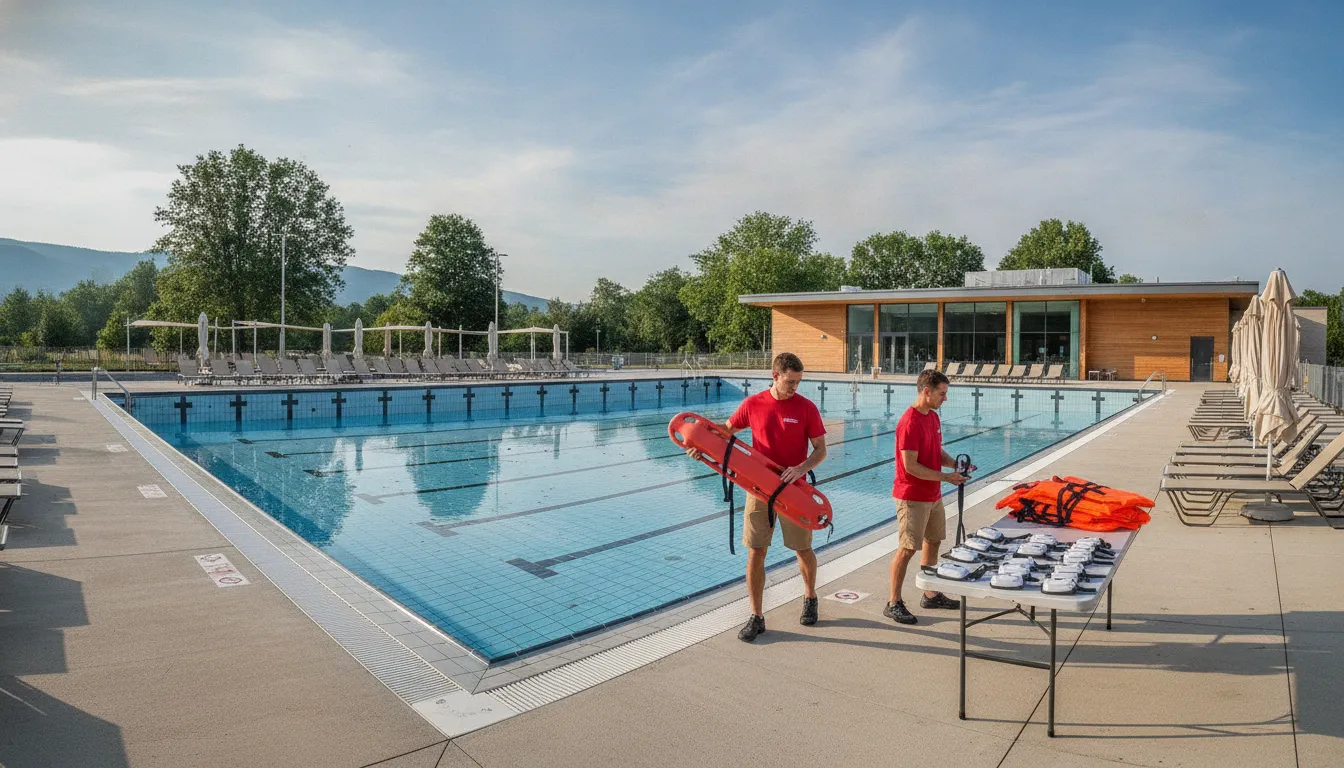
Drowning-detection technology can help lifeguards identify a swimmer who remains submerged beyond the configured threshold. WAVE's system uses swimmer wearables and alerts staff through vibrating bracelets and facility alerts. This makes it a force multiplier for trained lifeguards, adding information while staff continue to supervise and respond.
Seasonal operators with pools or natural-water swim areas can explore how waterfront safety technology supports summer programs. The goal is not to rely on a single tool. It is to connect trained people, tested procedures, working rescue gear, and an additional alert layer.
When should seasonal facilities deploy safety technology?
Seasonal facilities should begin planning and testing safety technology early enough to resolve equipment, coverage, and training issues before opening. Deployment should be followed by staff drills, documented daily checks, and a midseason review. At closing, equipment should be cleaned, checked, and stored according to the facility's procedures.
Pre-season setup and testing
Start with the operating calendar and work backward from opening day. Allow time to confirm the intended setup, prepare wearables and alerts, test the supervised area, train staff, and correct issues. WAVE is wireless and wearable, so it does not require the permanent construction associated with camera-based installations, which can suit seasonal operations.
Testing should reproduce normal operating conditions. Confirm that staff can recognize and act on alerts from the locations they will supervise. Repeat the test after correcting any issue. Then document the approved setup so daily opening staff know what ready status looks like.
Daily checks during peak season
Once the facility opens, complete a brief equipment check before swimmers enter. Confirm rescue gear placement, medical supply readiness, barrier condition, and the status of any configured technology. Record issues and keep affected equipment out of service until the responsible owner has resolved them.
Daily routines should also cover wearable distribution and return when applicable. Clear instructions help staff keep equipment available and prepared for the next session. A short, consistent log provides useful evidence for managers and makes recurring problems easier to identify.
Midseason review and end-of-season care
At midseason, review checklists, drill notes, equipment issues, and staff feedback. Determine whether crowd patterns or operating changes require different equipment placement, more training, or an updated procedure. This is also a good time to revisit the facility's layered drowning-prevention strategy.
At closing, clean, dry, inspect, and store equipment according to its instructions and the facility's procedures. Document items that need repair or replacement before the next opening. Good off-season records shorten next year's planning cycle and reduce the risk of discovering unresolved problems at the last minute.
Why portable wireless technology fits seasonal operations
Portable wireless technology fits seasonal operations because it can add an alert layer without the permanent construction required by camera-based systems. WAVE uses wearable sensors and configured alerts to support lifeguards in clear, dark, or murky water. It can be included in pre-season setup, daily checks, and off-season storage plans.
Support pools and natural-water sites
Camera-based tools depend on visibility, which can limit their usefulness in dark or murky water. WAVE's wearable approach does not depend on seeing through the water. That distinction can matter for camps and supervised natural-water facilities as well as traditional pools.
When a swimmer wearing AquaSense remains submerged beyond the configured threshold, the system alerts staff. Guards still make decisions and perform the response. This division of roles keeps the technology in its proper place as a supplemental layer that supports, rather than replaces, trained supervision.
Plan for the facility and budget
Every facility should assess its water area, operating model, staffing, and safety priorities before choosing equipment. Consider how staff will distribute, collect, check, and store wearables, as well as how new alerts fit the emergency plan. A technology purchase without an operating process will not deliver the same value as a fully integrated plan.
WAVE offers subscription-based options that can help facilities avoid a large upfront capital purchase. Operators can review WAVE pricing and system configurations, then discuss the appropriate approach for their supervised aquatic environment. Confirm current equipment quantities, technical specifications, and pricing directly with WAVE before making budget decisions.
Keep the plan working throughout the season
Keep the plan working by using daily checks, scheduled audits, regular drills, and documented follow-up. Opening-day readiness is only the starting point. Managers should monitor equipment condition, staff confidence, alert status, and recurring issues throughout the season, then use those findings to improve operations.
Create a daily opening and closing routine
A daily checklist should be short enough to complete consistently but thorough enough to identify critical problems. During opening, verify barriers, rescue gear, medical supplies, required signage, and any configured technology. During closing, account for portable equipment and record damage, low supplies, or maintenance needs.
Make the response to a failed check explicit. Staff should know whom to notify, how to document the issue, and whether an area or item must remain unavailable. A checklist creates value only when failed items trigger action.
Run scheduled equipment audits and drills
Daily checks confirm immediate readiness, while scheduled audits examine equipment condition and records more deeply. Use audits to review wear, batteries, supply levels, recurring problems, and completion of corrective actions. Pair them with drills that test whether staff can use the equipment under realistic conditions.
Managers should also review whether staff understand the role and limits of each safety layer. Rescue tools support response, barriers help limit access, supervision remains essential, and drowning-detection alerts provide added information. This shared understanding helps prevent overreliance on any single measure.
Learn from issues without waiting for the season to end
When a check, drill, or real response exposes a problem, capture the lesson promptly. Record what happened, which equipment or procedure was involved, what immediate action was taken, and who owns the longer-term correction. Review patterns with the appropriate leaders rather than treating each issue as an isolated event.
Close the loop by confirming that corrective work is complete and retesting the affected part of the plan. If staff found a tool difficult to access, revise its placement and repeat the drill. If checks repeatedly identify the same equipment problem, investigate its handling, storage, or maintenance process. Continuous improvement keeps seasonal readiness from fading after opening day.
Frequently Asked Questions
These answers address common questions about building and maintaining a layered seasonal safety plan. Facility leaders should also confirm local requirements, follow equipment instructions, and align every decision with their site's emergency action plan.
What are the most important layers of pool safety defense?
The most important layers include controlled access, attentive lifeguard supervision, trained staff, clear procedures, working rescue and medical equipment, and swimmer education. Drowning-detection technology can add another layer by alerting guards to a prolonged submersion event. No single layer replaces the others, so managers should test how they work together.
Why are seasonal pool safety covers important?
Seasonal pool safety covers can help restrict access and keep debris out when a pool is closed. Inspect the cover and its attachment points for damage before use, and follow its instructions. A cover is one part of an access-control plan and does not replace barriers, supervision, or other required safety measures.
What pool alarm systems are best for detecting unauthorized access?
Gate and access alarms are designed to notify staff when someone enters a restricted area. The appropriate system depends on the facility, local requirements, and operating plan. Access alarms serve a different purpose from WAVE AquaSense swimmer wearables, which alert staff when a participating swimmer remains submerged beyond the configured threshold.
How should commercial pools choose between different types of safety barriers?
Commercial pools should choose barriers by reviewing local codes, facility layout, operating conditions, durability, access points, and maintenance needs. Gates should support controlled access and work as intended every time they are tested. Have the proposed setup reviewed by the appropriate local authority or qualified safety professional before opening.
Turn readiness into a repeatable system
A strong seasonal safety plan is not a one-time shopping list. It is a repeatable operating system that connects equipment, people, procedures, and documentation. Start early, assign clear owners, test every layer in realistic conditions, and keep checking throughout the season. This disciplined approach helps lifeguards focus on protecting swimmers while managers maintain a safer supervised environment.
