
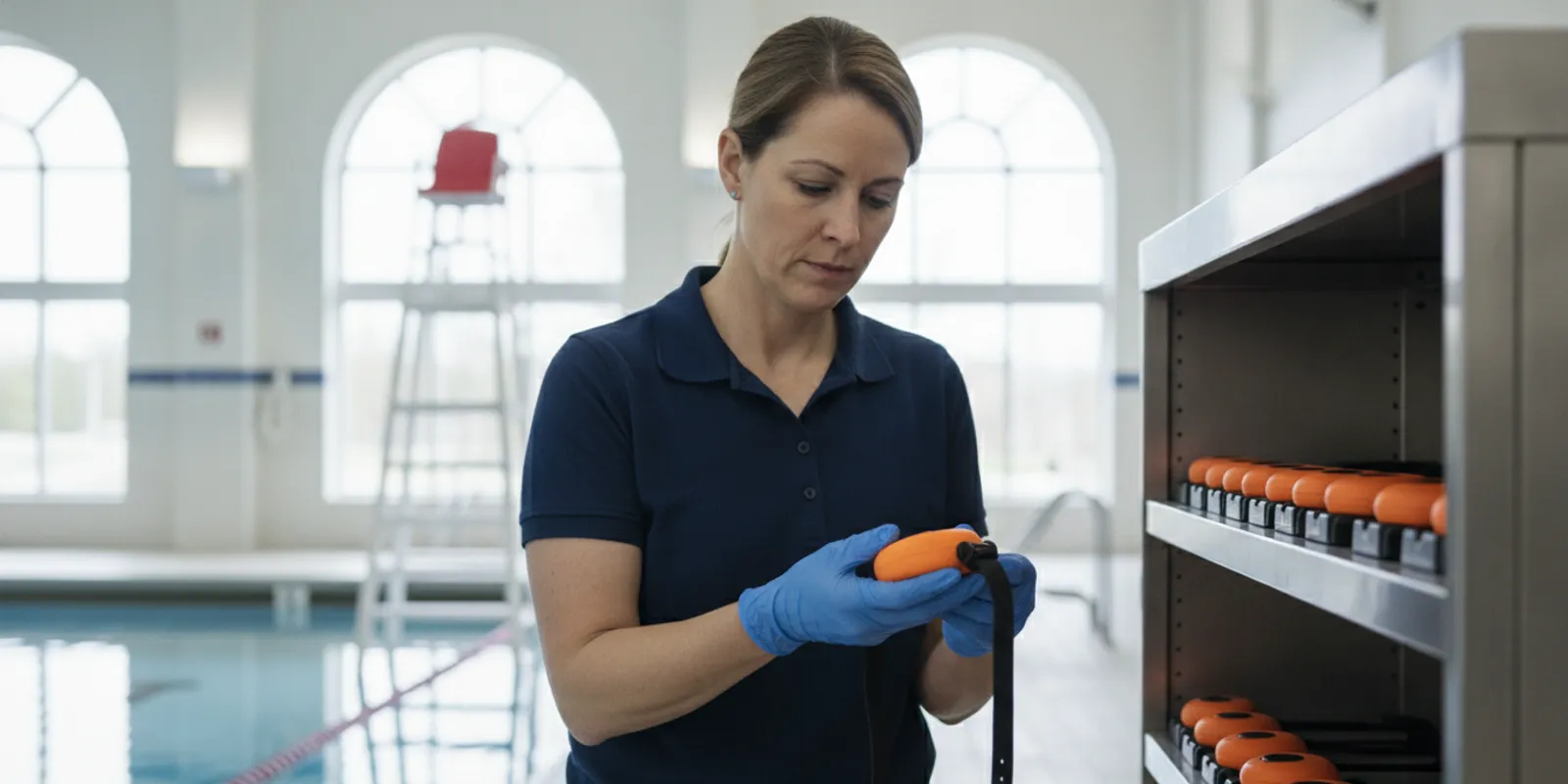
Swimmer wearable maintenance for aquatic facilities is not just a matter of keeping devices clean. A dependable program also covers inspection, assignment, alert-path testing, staff readiness, records, and decisions about when a wearable should be taken out of service. For aquatics directors, the goal is to keep the equipment ready to support a supervised safety plan without adding unclear tasks to busy shifts.
AquaSense swimmer wearables are non-tethered and have a multi-year battery, so they do not require daily recharging. That does not mean facilities should skip routine checks. Maintenance instructions vary by device and configuration; follow the current manufacturer guidance for cleaning, inspection, battery status, storage, and retirement. Treat wearable technology as an additional layer that supports lifeguards, not as a substitute for active supervision, training, or an emergency action plan.
What should swimmer wearable maintenance include?
A workable program gives each shift clear ownership of wearable readiness. Staff should know how devices are assigned, what they inspect, how they verify alerts, where they record issues, and who can remove a device from use. Follow device-specific instructions rather than assuming every wearable can be cleaned, stored, or tested the same way.
Wearable maintenance is a chain of small operational controls. A device can be physically intact but assigned to the wrong person, not communicating with its monitoring system, or unsupported by staff who know how to respond to an alert. Conversely, a sound process makes it easier to identify a problem before a busy swim session.
Build the program around five connected activities:
- Preparation: Keep current instructions, designated supplies, a device inventory, and a written check procedure where staff can find them.
- Inspection: Look for visible damage, missing components, contamination, or other conditions identified in the manufacturer's instructions.
- Functional readiness: Confirm the wearable is assigned and operating as intended, and verify the complete alert path using an approved test process.
- Response readiness: Make sure staff understand what an alert means, who responds, and how the team follows its emergency action plan.
- Documentation: Record checks, problems, corrective actions, and decisions to return a device to service or retire it.
These controls should complement the facility's existing aquatic emergency action plan and staff training. They should not create an impression that technology alone can prevent every incident. A wearable alert is useful only when equipment, communications, and people work together.
Setting up a swimmer wearable maintenance program
Start with a written process that fits the facility's device instructions and daily operating pattern. Name a program owner, assign shift-level responsibilities, and define what happens when an item fails a check. Then train staff and review the process after equipment changes, operational changes, or a problem.
Before setting a schedule, establish a clear baseline. List each wearable and its identifier, the monitoring equipment it works with, where it is stored, and how the facility assigns it. Use the current product documentation for requirements that depend on a particular model. Do not copy a procedure from another facility unless it matches your own equipment and manufacturer's directions.
Assign ownership and responsibilities
Choose one person to oversee the program and make sure daily tasks have an owner on every shift. The program owner can maintain the device list, keep instructions current, review records, and coordinate questions with the vendor or technical support. Shift leads can confirm that assigned checks were completed and that unresolved issues are passed to the next team.
Use role names in the procedure rather than relying on one employee's memory. For example, identify who completes a pre-opening inspection, who verifies that a reported fault is recorded, and who authorizes a device to return to use after repair or replacement. Staff should know the escalation contact if an alert or connection problem cannot be resolved within their role.
Define what counts as ready for use
Make readiness concrete. Your procedure should say how staff identify the correct device, check the condition and status indicators specified by its maker, and confirm that it is assigned and connected as intended. Add any facility-specific steps for storage, distribution, and collection. Keep the instructions concise enough to use during a shift, with more detailed manufacturer guidance available nearby.
Build device checks into the rhythm of operations instead of leaving them as an occasional project. Depending on the manufacturer's instructions and facility use, a team may complete an inspection before opening, confirm assignment during swimmer check-in, and account for devices when a session ends. The important point is to set a schedule that is both appropriate to the equipment and consistently achievable.
Keep procedures and training aligned
Train new staff before they take responsibility for issuing or checking equipment. Review the procedure with existing staff when a product, system configuration, or response role changes. A short practice can clarify who receives an alert and how the alert fits into the facility's established response. Avoid treating a maintenance check as an emergency-response drill unless that drill is designed and supervised under your approved procedures.
Facilities comparing equipment can review WAVE's GUARDian Hub information and swimmer equipment overview as product-specific context, then confirm applicable operating details with current documentation. The broader how-it-works overview can help staff understand how wearables fit into the monitoring approach.
Which routine checks belong on a facility checklist?
Separate visual condition checks from functional checks and staff-response checks. One does not prove the others. Record the result, and if a check fails or a device's status is uncertain, follow the facility's procedure to remove it from service until an authorized person resolves the issue.
A checklist turns expectations into repeatable actions. It should use plain language, identify who performs each step and when, and refer staff to the correct device instructions for model-specific details. Avoid writing a generic checklist that promises a device is safe based only on appearance.
| Check area | What staff should verify | What to do if there is a problem |
|---|---|---|
| Identification and assignment | Confirm the device is identifiable, accounted for, and issued according to facility procedure. | Pause assignment and reconcile the inventory or contact the shift lead. |
| Physical condition | Inspect the device and components for visible damage or conditions listed in current manufacturer instructions. | Mark it unavailable, record the issue, and route it for evaluation. |
| Cleaning and storage | Use only approved cleaning methods and return it to the designated storage location. | Ask the program owner to check instructions if compatibility is uncertain. |
| Battery or status indication | Check the status using the specific method and thresholds provided by the manufacturer. | Do not guess at remaining service life; follow the documented escalation or replacement process. |
| Communication and alert pathway | Complete an approved functional check from wearable through the facility alert and staff notification steps. | Take affected equipment out of service as needed and notify the designated technical contact. |
| Staff readiness | Confirm responsible staff know the alert response and their role in the facility's emergency action plan. | Provide a briefing or training before relying on the normal operating workflow. |
The table is a planning framework, not a substitute for a product manual. A WAVE AquaSense wearable has a multi-year battery and does not require daily recharging, but staff should still use its current instructions for battery or status checks and replacement decisions. Do not invent a charging routine or battery threshold for a device whose documentation does not specify one.
Test the complete alert pathway with a defined procedure
A functional check should confirm the steps that matter to your configuration, not just that a wearable powers on. Follow the current approved test method and verify the expected notification reaches the designated staff or alert point. Staff should know how to distinguish a test from a real alert, how to end the test, and how to record a failed or incomplete result. If the test cannot be completed as described, treat the uncertainty as an issue to escalate rather than assuming the system is ready.
Plan the timing and communication so a maintenance test does not confuse swimmers, guards, or other facility employees. Notify the appropriate team members before beginning, use the designated test process, and tell them when it is complete. Do not simulate an emergency in a way that could be mistaken for a real incident, and do not make swimmers part of a test unless the manufacturer and facility have an approved procedure for doing so. If a test generates an unexpected alert, follow the facility's response and documentation process.
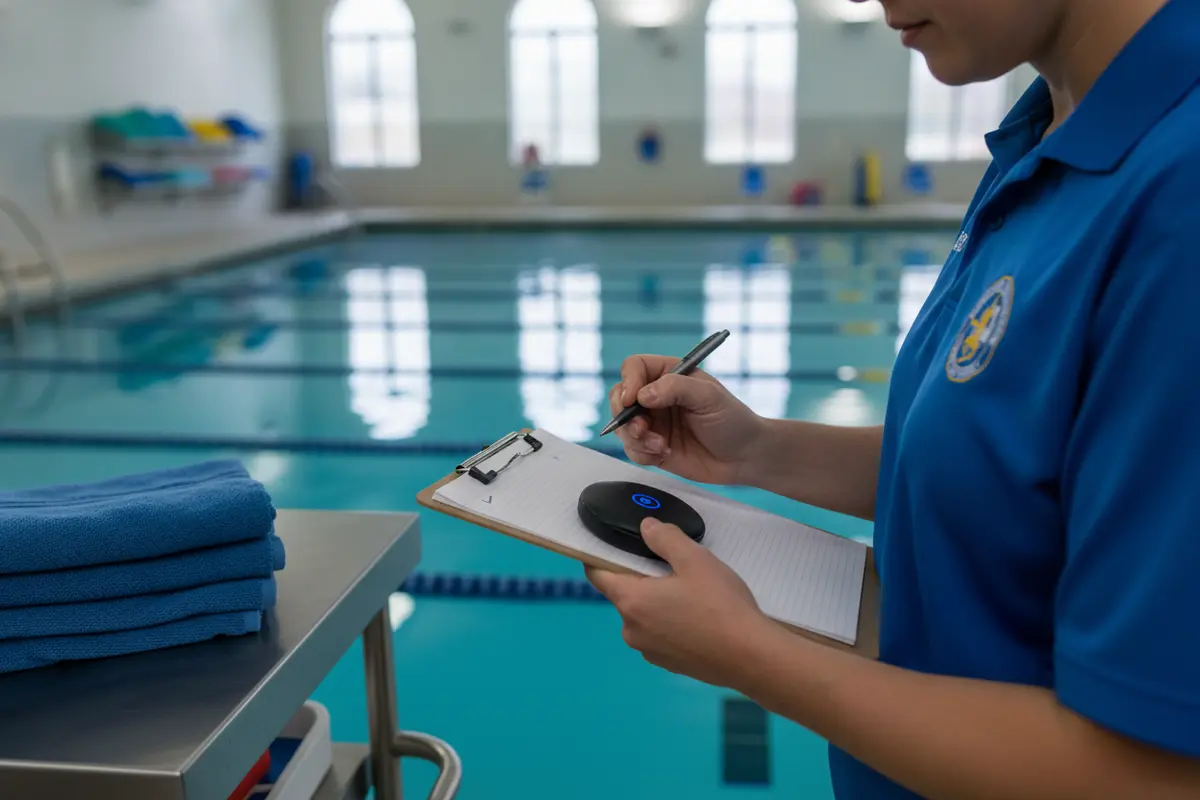
Keep the record proportionate but useful: note the test date, equipment involved, expected and observed alert behavior, staff involved, and any follow-up. This creates a history that helps a supervisor see whether checks are being completed and whether issues recur. It also makes handoffs more reliable when equipment or support requests are still being addressed.
Facilities may also want a simple red-tag or electronic hold status so staff can distinguish equipment that is available from equipment awaiting evaluation. Make sure the hold process does not allow a questionable device to drift back into circulation. Record who changed the status and what condition must be met before it is returned to use.
Cleaning, storage, and inspection procedures
Use the manufacturer's cleaning and storage instructions as the source of truth. Staff should know which materials and methods are permitted, how to handle a device that is wet or contaminated, and where it belongs between sessions. Inspect for visible changes without opening or modifying equipment unless the instructions explicitly authorize that work.
Shared equipment needs a practical handling routine. Explain when a device is cleaned, which staff member completes that task, and how a completed cleaning is noted if the facility tracks it. If the correct product or method is unclear, pause and check the documentation or ask the manufacturer rather than improvising with chemicals or tools.
Storage matters because equipment can be misplaced, mixed with items awaiting service, or exposed to conditions outside its instructions. Use a consistent location and a way to keep ready-to-use devices separate from returned, damaged, or unassigned ones. If different models or configurations are in circulation, label or organize them so staff can readily select the right instructions.
During inspection, staff should look for the issues the manufacturer identifies and report unfamiliar changes. Do not disassemble a wearable, attempt an unauthorized repair, or assume a surface appearance confirms internal function. Use an approved functional check to assess the alert path, and let authorized support personnel handle faults beyond the scope of routine staff checks.
For facilities considering how monitoring technology fits into their overall approach, the pool safety tools guide and swimmer monitoring system overview provide related context. A 2022 review of wearable technologies for aquatic exercise explicitly excluded wearable sensors for swimming monitoring, so it should not be treated as evidence about drowning detection or a maintenance protocol; its scope is described in the review itself.
What should staff do when a wearable fails a check?
When a device fails, do not quietly reset, reissue, or repair it outside the approved procedure. Remove it from use when required, record the symptom and circumstances, notify the responsible person, and use the facility's established backup and response arrangements. Return it to service only after the appropriate resolution and check are documented.
A failure can be physical, operational, or uncertain. Examples include visible damage, an unexpected status indication, inability to complete an approved test, or a missing device. Staff need not diagnose the cause; their first job is to protect the integrity of the operating process by reporting what they observed and following the hold procedure.
Write down the device identifier, date and time, check or activity being performed, observed symptom, staff member reporting it, and immediate action. Add the escalation contact, service case or reference if one exists, and the disposition when known. Keep records factual. A log should not claim that a device was repaired or validated if the facility has not received that confirmation.
Think through the effect of unavailable equipment before a session begins. Follow facility policy for adjusting assignments or operations, and do not allow a wearable program to create a false sense that normal supervision can be reduced. The lifeguard team remains central to surveillance and response. WAVE describes its system as a force multiplier that supports staff with alerts, not a replacement for lifeguards.
If your team needs to understand the system's place in the larger safety plan, review the facility's frequently asked questions and relevant public pool safety equipment guidance. For unresolved equipment questions, use the manufacturer's current support route rather than relying on an old checklist or informal advice.
Planning replacement and program reviews
Plan for wearable replacement using documented condition, manufacturer guidance, and operational records rather than an assumed universal lifespan. Review the whole program periodically: device status, staff understanding, alert workflow, records, and whether the procedure still matches the facility's equipment and use.
Multi-year battery life is useful for planning, but it is not a reason to wait for a battery problem before reviewing inventory. Track each wearable's status and service history, and use the manufacturer's stated limits and replacement guidance. If the device reaches a defined end-of-life condition, is damaged beyond authorized repair, or cannot pass the approved check, take the appropriate action under facility procedure.
Use an inventory that supports decisions
A useful inventory does more than count devices. Include a unique identifier, model or configuration, current assignment or storage location, readiness status, and any open service issue. Add purchase, activation, or warranty information only when the facility has reliable records and a practical reason to maintain it. Keep access limited to staff who need it, and choose a format that can be updated during normal operations.
Compare the available, assigned, held, and missing devices with the facility's actual operating needs. The purpose is not to create a universal device-to-swimmer ratio, but to spot a mismatch before it becomes a last-minute surprise. If the facility changes session structure, adds a program, or expands the monitored area, review whether the existing inventory and alert workflow still fit. Refer configuration questions to WAVE or the relevant manufacturer instead of assuming that adding wearables alone resolves a coverage question.
Make handoffs explicit
Maintenance can fail between shifts even when each employee performs their own checks. A simple handoff should identify devices taken out of service, unresolved alerts or communication issues, completed service actions, and any check that remains due. The outgoing employee should pass the information to a named role, and the incoming employee should acknowledge open items through the facility's normal log or communication process.
Keep a clear distinction between a report and a resolution. For example, a note that says “device tested” is less useful than one that identifies the check, result, date, and person who completed it. If equipment is sent for service or exchanged, update the inventory so the replacement is not confused with the original. Close the record only when the responsible person has confirmed the disposition.
Review the process, not only the equipment
During a periodic review, look for repeat problems and process gaps: checks left blank, inconsistent device identification, equipment repeatedly placed on hold, or staff who are unsure whom to notify. These patterns can point to a need for clearer instructions, revised shift ownership, or a vendor question. They are not by themselves proof of a device defect, so separate observed facts from possible explanations.
Use a brief review agenda: confirm that current manufacturer instructions are accessible; reconcile the inventory against devices on hand; check that unresolved issues have an owner; ask staff whether the workflow fits their shifts; and document any approved change. Assign each action to a role with a completion date. If no change is needed, record that the review occurred and why the existing process remains appropriate.
Include replacement planning in operational and budget conversations. List the wearables and supporting equipment in use, their current status, known service needs, and any planned changes in swimmer operations. For current system options and commercial terms, consult WAVE's pricing information directly; do not base a budget on outdated figures or assume that a published plan covers every facility's configuration.
Review after any device or monitoring-system change, a failure or near miss involving the alert path, a change in staff roles, or a revision to the facility's emergency action plan. Ask staff whether the check procedure is usable during real shifts. Compare completed records with the written schedule, and fix gaps with a named owner and due date.
Maintenance also benefits from regular communication between operations, aquatics leadership, and whoever manages technical support. A short review can establish whether open issues are resolved, whether a procedure needs clarification, and whether new staff have received the required orientation. Keep changes versioned so employees can tell which instructions are current.
Facilities that want to discuss fit, deployment, or product-specific procedures can request a conversation with WAVE. Continue to base day-to-day inspection and use on the current product documentation and the facility's own safety plan.
Frequently Asked Questions
Do swimmer wearables need to be checked every day?
Facilities should set a routine that follows the manufacturer's instructions and their own operating procedures. The schedule may include checks before use or at other defined points, but the exact steps and frequency should be based on the specific equipment, not a universal rule.
Does AquaSense need to be charged after each swim session?
No daily recharging is required for AquaSense swimmer wearables, which have a multi-year battery. Staff should still follow current product instructions for status checks, handling, and replacement planning.
Can staff clean a wearable with any pool disinfectant?
Do not assume a cleaning product or method is compatible. Follow the current manufacturer's cleaning instructions, and ask the manufacturer or designated support contact if the directions are unclear.
What should a facility do with a wearable that fails an inspection?
Follow the facility's hold and escalation process. Record the device and observed issue, prevent unintended reassignment when required, and return it to service only after the appropriate resolution and check are documented.
Does wearable maintenance replace lifeguard training or supervision?
No. Wearable detection and alert technology adds a layer of support, while trained lifeguards, active supervision, and the facility's emergency action plan remain essential parts of aquatic safety.
What belongs in a maintenance log?
At minimum, record the device identifier, date, check performed, result, staff member, reported issue, immediate action, and eventual disposition. Adapt the log to facility procedure and any manufacturer recordkeeping guidance.
A consistent maintenance routine helps staff know which equipment is ready, what to do when something is uncertain, and how the alert process fits into lifeguard-led operations. Keep instructions current, make responsibilities clear, and treat every wearable as one component of a broader aquatic safety plan.
